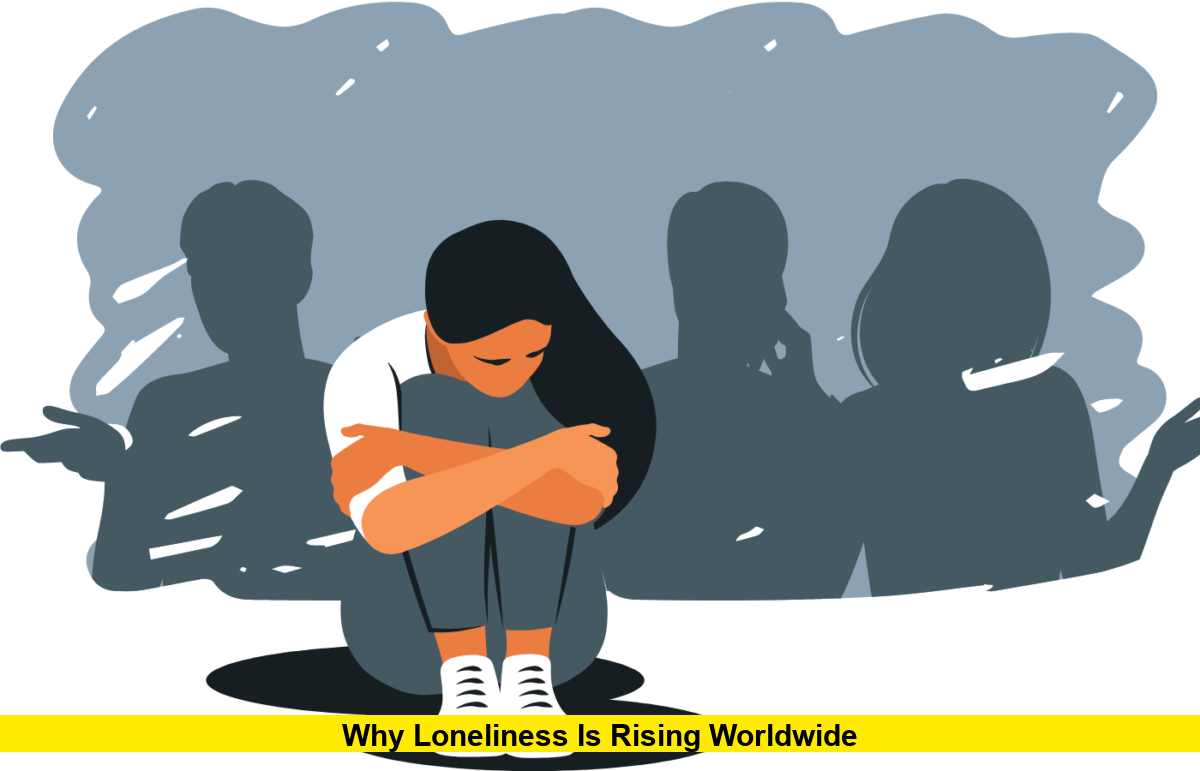
We live in an era of unprecedented connectivity. Billions of people carry smartphones, maintain dozens of social media profiles, and can video-call anyone on the planet within seconds. Yet, paradoxically, the world has never felt lonelier. From the crowded metros of Mumbai to the sprawling suburbs of Chicago, a quiet epidemic is spreading — one that health authorities are now calling one of the most urgent public health crises of our time.
This article explores why loneliness is rising worldwide, backed by the latest research, real-world examples from India and the USA, and practical steps you can take to fight back.
The Scale of the Problem: What the Numbers Say
The statistics are staggering. According to the World Health Organization’s landmark June 2025 report from the Commission on Social Connection, 1 in 6 people worldwide experiences persistent loneliness — linked to an estimated 100 deaths every hour globally, or more than 871,000 deaths annually. Globally, approximately 33% of adults report feeling lonely, with rates varying widely across countries and cultures.
In the United States, the picture is equally alarming. The U.S. Surgeon General’s 2023 advisory declared loneliness a public health crisis, noting that roughly half of all American adults experience measurable loneliness — more than those living with diabetes. More recent AARP data from December 2025 reveals that 40% of U.S. adults now report being lonely, a significant rise from 35% recorded in both 2010 and 2018.
Perhaps most counterintuitively, it is young people — not the elderly — who are reporting the highest rates. Gallup’s 2024 data confirms that adults aged 18–34 are the loneliest age group of all. A 2026 multi-country study from Washington University found that nearly half of young adults report loneliness, and that between 2010 and 2023, anxiety disorders rose by about 60% and depressive disorders by about 26%.
Key Points Summary
╔════════════════════════════════════════════════════════════════════╗
║ – WHO's June 2025 report links loneliness to 871,000+ deaths      ║
║   annually — 100 deaths every hour worldwide.                     ║
║ – 1 in 6 people globally experiences persistent loneliness.       ║
║ – In the USA, 40% of adults 45+ now report feeling lonely,        ║
║   up from 35% in prior years.                                     ║
║ – In India, 43% of urban residents report feeling lonely,         ║
║   placing India among the top 3 loneliest nations surveyed.       ║
║ – Young adults (18–34) are the loneliest age group worldwide,     ║
║   challenging assumptions about digital connectivity.             ║
║ – Loneliness carries a health risk equivalent to smoking          ║
║   15 cigarettes per day, per the U.S. Surgeon General.           ║
║ – Social isolation costs the U.S. Medicare system an estimated    ║
║   $6.7 billion annually in excess spending.                       ║
║ – The WHO, UK, and multiple governments now treat loneliness       ║
║   as a formal public health and policy priority.                  ║
╚════════════════════════════════════════════════════════════════════╝
Why Is Loneliness Rising? The Root Causes
The Decline of In-Person Connection
One of the most consistent trends across industrialized nations is the steady collapse of face-to-face interaction. The OECD reported that among 16–24-year-olds, the proportion who had daily in-person contact with friends fell from 44% in 2015 to 36% in 2022 — a continuation of a decline that had already begun in the preceding decade. For older adults (65+), the share who reported never meeting friends rose by 5.5 percentage points between 2015 and 2022.
People are simply spending less time with each other in the physical world.
Social Media: Connection Without Depth
Social media platforms promise connection but increasingly deliver the opposite. Psychologists now use the term “performative intimacy” to describe the dynamic: you share everything, accumulate likes, and yet feel entirely invisible. The architecture of digital platforms is optimised for engagement — not genuine relationship-building. Endless social comparison through curated feeds intensifies feelings of inadequacy, while the quantity of online contacts rarely translates into depth of friendship.
Remote Work and the Collapse of Workplace Community
The shift to remote and hybrid work — accelerated dramatically by the COVID-19 pandemic — has removed one of the most reliable engines of adult friendship: the office. For millions of people, especially those who live alone, the workplace was the primary source of daily social interaction. Without it, days can pass without any meaningful human contact.
The Breakdown of Community Institutions
Civic life — the glue that once bound neighbourhoods together — has eroded. Participation in religious organisations, local clubs, neighbourhood associations, unions, and civic groups has fallen sharply across Western nations over several decades. These institutions provided not just connection, but a sense of belonging and shared purpose. Their decline has left a social vacuum that digital substitutes have not adequately filled.
Geographic Mobility and Urban Transience
Modern economies demand that people move — for education, for jobs, for housing affordability. Each move tears apart the social fabric built over years. In cities like Bengaluru, London, or New York, people live as transient neighbours in apartment blocks, rarely knowing the person next door. Urbanisation without community design creates physical density alongside profound social isolation.
The Rise of Single-Person Households
The number of people living alone has nearly doubled globally over the past 50 years. While living alone does not automatically cause loneliness, it removes the built-in social contact that cohabitation provides, making intentional socialising more critical — and more effortful.
Economic Stress and Inequality
Financial pressure compounds social disconnection. Those facing economic hardship experience loneliness at roughly double the rate of financially stable peers — approximately 32% versus 15%. Unemployment, long working hours, and financial anxiety all reduce the time, energy, and resources available for social life.
Real-World Example: India — Lonely in a Crowd
India presents perhaps the most striking paradox of the loneliness epidemic. With a population of over 1.4 billion people and a culture historically rooted in extended family networks and community life, loneliness might seem like a foreign concept. But the data tells a different story.
A global Ipsos survey found that 43% of urban Indians report feeling lonely most of the time, placing India among the top three countries in terms of reported loneliness. India also has over 750 million internet users and a median age of just 28 — the most digitally connected young population on earth — and yet loneliness is rising fastest among the people who are online the most.
The causes are structural. Rapid urbanisation has uprooted millions from their hometowns, families, and familiar social networks. Young professionals aged 25–35 in cities like Bengaluru, Gurugram, Pune, and Hyderabad follow a “work-sleep-party” routine that leaves little room for building deep relationships. A survey across 14 firms found that 56% of working young adults openly admitted to loneliness, with 64% of women acknowledging it compared to 36% of men.
Mental health platforms like YourDOST and iCall report a surge in anxiety, depression, and feelings of emptiness among 18–30-year-olds in Mumbai, Delhi, and Pune. The WHO has separately reported that 1 in 4 Indian children aged 13–15 suffers from depression — often a consequence of isolation.
The story of Sarthak, a 24-year-old journalist from Mumbai, is emblematic: “After moving to the city for work, I felt lost in the crowd. I had hundreds of contacts but no one to really talk to.” Millions of urban Indians could tell the same story. The collapse of the joint family system, the rise of PG accommodations, and the disappearance of neighbourhood public spaces have dismantled the accidental encounters that once made community feel effortless.
Real-World Example: USA — A Public Health Emergency
In the United States, loneliness has become a formal national emergency. In May 2023, U.S. Surgeon General Dr. Vivek Murthy issued a landmark advisory declaring loneliness and social isolation an epidemic, noting that it is “far more than just a bad feeling” — it is a severe public health risk. His message was stark: more Americans are lonely than have diabetes, and the health consequences are equivalent to smoking 15 cigarettes a day.
The advisory pointed to a grim health picture. Social isolation increases the risk of premature death by 29%, raises the risk of heart disease, stroke, and dementia, and costs the Medicare system an estimated $6.7 billion annually in excess spending. The crisis predates COVID-19: roughly half of American adults were already lonely before the pandemic began.
Recent data from AARP (December 2025) confirms the problem is not improving. Loneliness among adults 45 and older has risen to 40%, up from 35% in both 2010 and 2018. Men now report higher rates than women (42% vs. 38%), a striking reversal of historical trends.
Young Americans are also deeply affected. A 2026 Washington University study found that nearly half of young adults in an eight-country comparison reported loneliness, with the USA among the most affected. In response, the Surgeon General published a National Strategy to Advance Social Connection — the first of its kind — outlining actions for individuals, communities, organisations, and governments.
The story of American loneliness is visible in its infrastructure: suburban sprawl designed around cars rather than people, the disappearance of “third places” (cafés, libraries, parks, clubs), and the erosion of civic participation. Former Surgeon General Murthy has described it as a structural crisis: “If I tell you that more people are struggling with loneliness than have diabetes in the United States, that gives you a sense of just how common this is.”
The Health Consequences: More Than a Feeling
Loneliness is not merely an emotional discomfort. It is a biological stressor with measurable consequences for physical health.
- Cardiovascular disease: Loneliness significantly increases the risk of heart disease and stroke.
- Dementia: Social isolation is a recognised risk factor for cognitive decline.
- Immune function: Poor social support has been shown to reduce immune response, including susceptibility to viral infections.
- Mental health: Loneliness and social isolation are the primary contributing factors to depression and anxiety in multiple large-scale studies. Between 2010 and 2023, anxiety disorders increased by 60% and depressive disorders by 26% worldwide — with loneliness playing a central role.
- Premature death: Social isolation increases the risk of early mortality by 29% — equivalent to the risk posed by smoking 15 cigarettes a day.
For societies, the costs are equally staggering. Reduced workplace productivity, lower academic achievement, increased healthcare spending, and the erosion of social trust and community cohesion all follow in loneliness’s wake.
Who Is Most at Risk?
While loneliness affects people across all ages and backgrounds, certain groups face disproportionate risk:
- Young adults (18–34): Counterintuitively the loneliest age group globally, facing digital-first socialisation, delayed life milestones, economic pressures, and social comparison anxiety.
- Older adults (65+): Face physical mobility limits, bereavement, retirement from work, and geographic distance from family. In the UK, half of all older adults report that television is their main companion.
- Men: While historically less likely to report loneliness, men now report higher rates than women in the USA, and the OECD notes that between 2018 and 2022, men experienced the largest deteriorations in relationship quality.
- Economically disadvantaged groups: Unemployed individuals and those in the lowest income quintile are roughly twice as likely to feel lonely.
- Migrants and urban newcomers: Separated from their support networks, migrants face acute loneliness during resettlement — a pattern seen equally in India’s internal migrants and international diaspora communities.
- LGBTQ+ individuals: Research indicates significantly elevated rates of loneliness, particularly for those in unsupportive social environments.
Practical Steps to Combat Loneliness
Understanding why loneliness is rising is only the first step. Here are concrete, evidence-based actions you can take — at a personal, community, and policy level.
For Individuals
1. Prioritise in-person contact deliberately. Schedule regular face-to-face time with friends or family the same way you schedule work meetings. Research consistently shows that in-person interaction is far more effective at reducing loneliness than digital communication.
2. Join a group around a shared interest. Whether it is a running club, a book circle, a cooking class, or a volunteering organisation, shared activities create the repeated, low-pressure contact that is most likely to develop into genuine friendship.
3. Limit passive social media use. Set intentional boundaries around scrolling. Replace passive consumption with active, meaningful digital interaction — or better yet, use online connections as a bridge to real-world meetings.
4. Reach out first — and be consistent. Friendships require maintenance. Make it a habit to message, call, or check in with people in your network. Consistency matters more than frequency.
5. Seek professional support if needed. If loneliness is linked to anxiety, depression, or social avoidance, speaking with a therapist or counsellor can help address the underlying barriers. In India, platforms like iCall and YourDOST offer accessible support. In the USA, the 988 Suicide & Crisis Lifeline offers mental health guidance.
6. Practise vulnerability. Surface-level socialising rarely cures loneliness. Taking small steps toward deeper, more honest conversations — even with acquaintances — is one of the most effective routes to genuine connection.
For Communities and Organisations
7. Redesign workplaces for connection. Employers should invest in intentional team-building, in-person collaboration days, and formal mentoring programmes. Remote work flexibility is valuable — but social infrastructure at work must be actively maintained.
8. Create and protect “third places.” Local governments and urban planners should invest in freely accessible community spaces — parks, libraries, community centres, public squares — where people can gather without spending money.
9. Implement intergenerational programmes. Pairing younger and older people through mentoring, shared activities, or community gardening creates mutual benefit and reduces isolation at both ends of the age spectrum. WHO’s 2025 roadmap highlighted such community strategies as among the most effective.
10. Embed social prescribing in healthcare. Doctors and healthcare providers should be empowered to “prescribe” community activities, volunteering, and social groups alongside conventional treatment — a model already gaining traction in the UK and parts of Europe.
Government and Global Responses
Governments around the world are beginning to treat loneliness as a policy issue, not just a personal one.
The United Kingdom was the first country in the world to appoint a Minister for Loneliness (in 2018), following a national review that found more than 9 million people often or always felt lonely. This has since been embedded in UK public health strategy.
The United States Surgeon General’s 2023 advisory was accompanied by a National Strategy to Advance Social Connection — the first federal framework of its kind, outlining a roadmap for individuals, communities, organisations, and government.
The World Health Organization established a Commission on Social Connection and published a landmark report in June 2025, calling loneliness a global public health priority and laying out a global action roadmap. The report confirmed that loneliness is now linked to over 871,000 preventable deaths annually.
In India, while there is no dedicated national policy, awareness is growing. Urban planners, mental health professionals, and corporate HR teams are beginning to address what researchers call the “loneliness design flaw” embedded in India’s cities and workplaces.
The Way Forward: Connection Is Not Optional
Loneliness is rising for reasons that are structural, technological, economic, and cultural — not personal failings. The collapse of community institutions, the design of digital platforms, the architecture of modern cities, and the pace of working life have all conspired to make genuine human connection harder to find and harder to keep.
But the evidence is also clear that this is a solvable problem. Individual choices matter. Community design matters. Policy matters. The 871,000 deaths linked annually to loneliness are not inevitable. The epidemic did not emerge overnight, and it will not be reversed overnight. But awareness — the recognition that loneliness is a public health issue, not a private shame — is where every solution begins.
The antidote to loneliness is not more followers. It is fewer walls.
Have you felt the weight of loneliness in your own life, or seen it in your community? Share your experience in the comments below — your story might be exactly what someone else needs to hear today.