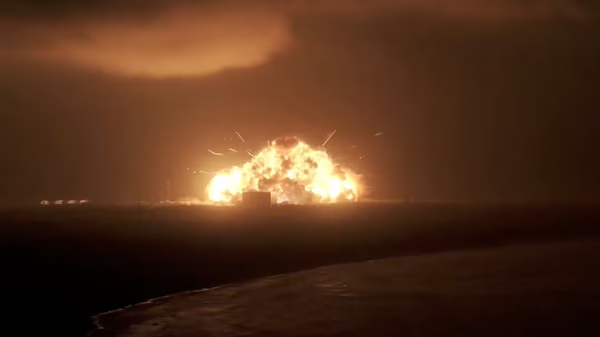
A Fiery Night at Cape Canaveral
In a dramatic and shocking turn of events, Blue Origin’s New Glenn rocket exploded on its launch pad on the evening of Thursday, May 28, 2026, sending a massive fireball into the night sky over Cape Canaveral, Florida. The explosion occurred during a routine pre-launch procedure known as a hot-fire (or static fire) test at Launch Complex 36 of the Cape Canaveral Space Force Station — and it has sent shockwaves through the commercial space industry.
Footage of the incident, captured live during a Spaceflight Now livestream, shows the rocket standing upright on its platform before a tremendous explosion erupts from the base, rapidly climbing the cylindrical vehicle and engulfing it in a giant ball of flame and smoke.
What Happened? The ‘Anomaly’ Explained
A hot-fire test is a controlled procedure where a rocket’s engines are briefly ignited while the vehicle remains bolted to the ground — a standard verification step before any actual launch. Blue Origin had been fueling the New Glenn rocket Thursday evening in preparation for just such a test.
At approximately 9:00 PM local time, everything went wrong.
Blue Origin released a brief but sobering statement on social media: “We experienced an anomaly during today’s hotfire test. All personnel have been accounted for. We will provide updates as we learn more.”
Jeff Bezos, the founder of Blue Origin, followed up with a personal statement: “All personnel are accounted for and safe. It’s too early to know the root cause but we’re already working to find it. Very rough day, but we’ll rebuild whatever needs rebuilding and get back to flying. It’s worth it.”
As of now, the root cause of the explosion remains under active investigation. It is also unclear how much damage has been done to the launch pad infrastructure or whether the rocket itself is a total loss.
No Injuries Reported — Emergency Response Swift
The most important news in all of this: no one was hurt. Brevard County Sheriff Wayne Ivey confirmed there were no reported injuries and stated that the current plan was to allow the contained fire from the explosion to burn itself out, with no danger or threat to the surrounding community.
Brevard County Emergency Management issued a public notice shortly after 9:30 PM, reassuring residents that no public hazard existed from fire, fumes, or other related threats. Emergency crews responded to the launch complex as a precaution, but officials confirmed the situation remained contained within the launch facility.
What Was This Mission For?
The New Glenn rocket was being prepared for its fourth ever flight — a mission targeting a June 4, 2026 launch date to deliver 48 satellites into low-Earth orbit for Amazon’s Project Leo (formerly known as Project Kuiper), the company’s broadband internet satellite network and direct competitor to Elon Musk’s Starlink.
Crucially, Amazon confirmed that none of the 48 Leo satellites were aboard the rocket at the time of the explosion.
This upcoming fourth mission was also set to be the first of 24 launches that Amazon has contracted Blue Origin to carry out — a massive commercial agreement that now faces serious uncertainty.
A Troubled Recent Track Record
The explosion is the latest in a string of setbacks for Blue Origin’s flagship rocket program.
New Glenn’s third flight, which took place on April 19, 2026, experienced its own significant failure. While the reusable first stage booster — nicknamed “Never Tell Me The Odds” — successfully landed on a drone ship for the second time, the rocket’s upper stage suffered a cryogenic failure and was unable to deliver an AST SpaceMobile BlueBird 7 satellite to its intended orbit, resulting in the total loss of the payload.
Following that failure, the Federal Aviation Administration (FAA) grounded New Glenn for investigation. The FAA only cleared the rocket to return to flight on May 22, 2026 — just six days before Thursday’s explosion.
The FAA confirmed awareness of Thursday’s incident, stating: “The FAA is aware that the Blue Origin New Glenn vehicle experienced an anomaly during a static fire test on the pad in Cape Canaveral, Florida around 9 p.m. local time on May 28. This test was not within the scope of FAA licensed activities. There was no impact to air traffic.”
What’s at Stake: NASA, the Moon, and National Security
The implications of this explosion extend well beyond a single satellite mission.
Just one day before the explosion, NASA Administrator Jared Isaacman had praised Blue Origin during a public speech for playing a pivotal role in the agency’s Artemis program — the initiative to return American astronauts to the Moon’s surface in 2028. Isaacman also revealed that NASA had awarded Blue Origin a $188 million contract to help build a Moon Base.
Following the explosion, Isaacman issued a statement acknowledging the seriousness of the situation: “Spaceflight is unforgiving, and developing new heavy-lift launch capability is extraordinarily difficult. We will work with our partners to support a thorough investigation of this anomaly, assess near-term mission impacts, and get back to launching rockets.”
He added that NASA would provide information on any impacts to the Artemis and Moon Base programs as it becomes available. Beyond NASA, Blue Origin has also been pursuing contracts to launch national security missions for the Pentagon — programs that will now face potential delays as a result of this incident.
Reactions From Across the Industry
The explosion drew responses from across the space community. Congressman Mike Haridopolos (R-FL), who represents the district encompassing Cape Canaveral, confirmed he had spoken directly with NASA Administrator Isaacman about the incident.
Elon Musk, Bezos’ most prominent rival in the space industry, posted on X: “Most unfortunate. Rockets are hard. I hope you recover quickly.”
The sentiment echoed the broader reality of commercial spaceflight: even well-funded, experienced teams can face catastrophic failures in a field with extremely thin margins for error.
Blue Origin’s Path Forward
Blue Origin had been planning as many as 12 New Glenn launches in 2026, an ambitious cadence aimed squarely at challenging SpaceX’s dominance in the commercial launch market. That schedule is now in jeopardy.
The company has not released a timeline for completing its investigation, assessing damage to the launch pad, or returning New Glenn to flight status. The June 4 Amazon Leo satellite launch is considered highly unlikely to proceed as planned.
New Glenn represents the culmination of nearly a decade of development by Blue Origin. Before it, the company operated its smaller New Shepard rocket for suborbital tourism and technology testing. New Glenn is the company’s first orbital-class vehicle, and its reliability — or lack thereof — will determine Blue Origin’s viability as a serious competitor in the commercial launch market.
Key Facts at a Glance
- Date of incident: May 28, 2026 (~9:00 PM ET)
- Location: Launch Complex 36, Cape Canaveral Space Force Station, Florida
- Rocket: Blue Origin New Glenn (would have been its 4th flight)
- Cause: Anomaly during hot-fire (static fire) engine test
- Injuries: None reported
- Intended mission: Deploy 48 Amazon Leo satellites (targeted June 4, 2026)
- Satellites on board during test: None
- FAA status: Investigation ongoing; test was outside FAA-licensed activities
- NASA response: Monitoring potential impacts on Artemis and Moon Base programs
This story is still developing — drop your thoughts in the comments below, and make sure to follow us for the latest updates as the investigation unfolds.