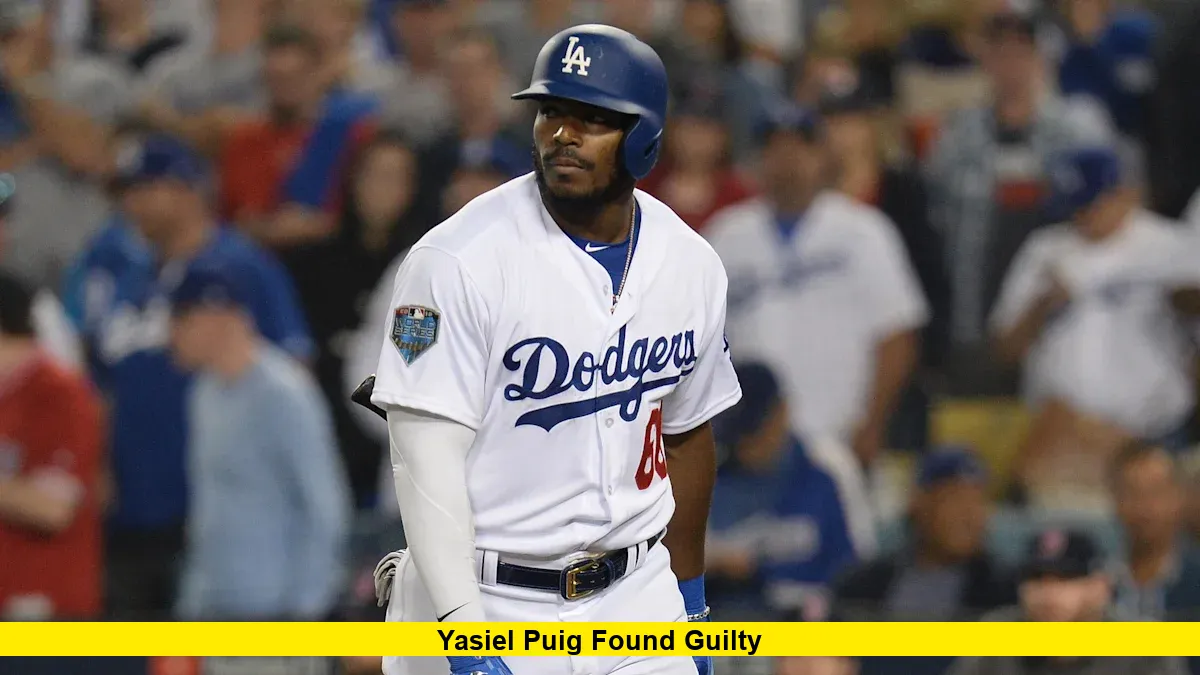
Former Major League Baseball outfielder yasiel puig has been convicted in federal court on charges tied to an illegal sports gambling investigation, marking a significant legal turning point for the once electrifying All-Star. A jury in Los Angeles found the 35-year-old guilty of obstruction of justice and making false statements to federal authorities after a closely watched trial that examined his involvement in an unlawful betting operation.
The verdict concludes a case that has unfolded over several years and now places the former Dodgers standout at risk of substantial prison time. Sentencing is scheduled for May 26, when a federal judge will determine the penalties.
A High-Profile Fall From the Spotlight
The conviction follows a multi-day federal trial in which prosecutors laid out evidence that the former outfielder misled investigators during a probe into an illegal sports betting ring. Jurors determined that he knowingly provided false information during a formal interview and took steps that amounted to obstruction of justice.
The case centers on a 2022 interview with federal agents. During that meeting, prosecutors argued, he denied key aspects of his connection to a sports wagering operation that had been under investigation for running an unlicensed bookmaking business.
Jurors ultimately agreed with the government’s argument that those denials were not mistakes or misunderstandings but deliberate falsehoods intended to derail the investigation.
How the Gambling Investigation Unfolded
Federal authorities began investigating a sports betting ring linked to a former minor league pitcher who operated an illegal bookmaking enterprise. The operation allegedly handled wagers from a network of clients, including professional athletes.
Evidence presented during the trial detailed how the former outfielder placed numerous bets on professional and collegiate sporting events in 2019. Records introduced in court showed hundreds of wagers over several months, involving football, basketball, and tennis matchups.
By mid-2019, he had accumulated a gambling debt that exceeded $280,000, according to court proceedings. Financial records indicated that he later obtained cashier’s checks to settle that amount. Prosecutors also stated that he continued placing bets afterward, eventually reaching nearly 900 wagers through accounts tied to the unlawful operation.
By the time federal agents began interviewing participants in the betting ring, investigators had already gathered financial data, communication records, and transactional evidence linking clients to the operation.
The Interview That Changed Everything
At the center of the prosecution’s case was a January 2022 meeting between the former MLB player and federal investigators. During that session, he was asked about his connections to individuals involved in the betting enterprise and about whether he had placed wagers through their platform.
Prosecutors presented evidence showing that he denied knowing central figures in the operation and claimed he had not engaged in sports gambling through their system.
In court, the government introduced communications and banking documentation that contradicted those statements. Jurors also heard about post-interview messages in which he acknowledged providing false answers during questioning.
Those admissions played a critical role in persuading jurors that the statements were knowingly deceptive.
Legal Strategy and Trial Arguments
Defense attorneys argued that language barriers and interpretation issues contributed to misunderstandings during the interview process. They contended that their client did not fully grasp certain questions posed by investigators and that his responses were mischaracterized.
They also emphasized that he had settled gambling debts years earlier and maintained that the betting activity itself was not the central issue before the jury. Instead, they framed the case as one about alleged miscommunication rather than intentional wrongdoing.
Prosecutors, however, focused sharply on the false statements and obstruction counts. They told jurors that the integrity of federal investigations depends on truthful cooperation and that knowingly misleading agents constitutes a serious federal offense regardless of the underlying conduct.
After deliberations, the jury returned guilty verdicts on both counts.
Potential Consequences at Sentencing
Obstruction of justice carries a potential maximum sentence of up to 10 years in prison under federal law. The false statement conviction can carry a penalty of up to five years.
Actual sentencing outcomes often depend on federal guidelines, criminal history, and judicial discretion. The former outfielder does not have a prior criminal record, which may factor into the calculation.
He remains free pending sentencing, released on personal recognizance. The court is expected to review sentencing memoranda from both the prosecution and defense in the coming months before issuing a final decision.
Legal analysts note that while statutory maximums are significant, federal sentences frequently fall below those limits depending on guideline ranges and mitigating factors.
Baseball Career Marked by Highs and Controversy
The athlete first burst onto the Major League scene in 2013 after defecting from Cuba and signing a lucrative contract with Los Angeles. He quickly became one of baseball’s most talked-about players, known for his powerful arm, aggressive baserunning, and charismatic personality.
He earned All-Star honors and played a central role in multiple postseason appearances. His tenure with Los Angeles lasted six seasons before he was traded in 2019.
After brief stops with Cincinnati and Cleveland, his MLB career ended that same year. He later played internationally, including stints in South Korea’s KBO League and in Mexico.
While his on-field production once captivated fans, off-field scrutiny followed him throughout his career. The federal conviction now adds a new and serious chapter to that narrative.
Why the Case Matters Beyond Baseball
The prosecution underscores the federal government’s emphasis on honesty during criminal investigations. Even when the underlying activity involves gambling rather than game-fixing, lying to investigators can carry severe legal consequences.
Sports betting has grown rapidly in the United States following the Supreme Court’s 2018 decision that opened the door to state-regulated wagering. Legal sportsbooks now operate in dozens of states.
However, illegal bookmaking operations remain subject to aggressive federal enforcement. Authorities have continued targeting underground networks that bypass state regulation and licensing requirements.
This case demonstrates that public figures and professional athletes are not insulated from prosecution when they become entangled in unlawful operations.
Impact on Reputation and Legacy
Public reaction to the verdict has been swift, with fans and analysts debating how the conviction will affect the former outfielder’s legacy. His dynamic playing style once made him one of the most recognizable young stars in baseball.
Now, discussions center on courtroom developments rather than athletic achievements.
Professional athletes often build post-career opportunities in broadcasting, coaching, or business ventures. Legal trouble can complicate those paths, particularly when convictions involve federal offenses.
For the former Dodger, the upcoming sentencing hearing will shape the next phase of his life, both personally and professionally.
The Road to Sentencing
In the weeks leading up to May 26, attorneys are expected to file arguments addressing sentencing factors. The court will evaluate the seriousness of the conduct, the defendant’s history, and federal guideline recommendations.
Judges may also consider expressions of remorse, acceptance of responsibility, and cooperation with authorities. Because he chose to proceed to trial rather than accept a plea agreement, the sentencing calculus may differ from what earlier negotiations contemplated.
A previous plea arrangement would have involved probation and a financial penalty. That deal was never finalized, and the case ultimately moved forward to trial.
The final sentence will bring closure to a case that has lingered in federal court for several years.
A Cautionary Tale for Athletes
The conviction of yasiel puig serves as a reminder that professional success does not shield individuals from legal accountability. Federal investigations demand truthful participation, and deviations from that standard can trigger serious consequences.
For players navigating the modern landscape of legalized sports betting, the case also illustrates the importance of understanding the difference between regulated wagering platforms and illegal operations.
While sports gambling is widely accessible across much of the country, unlicensed bookmaking remains a federal crime.
What Comes Next
As sentencing approaches, the former MLB star faces an uncertain future. The judge’s decision will determine whether he serves prison time, probation, or another combination of penalties.
Whatever the outcome, the case stands as one of the most prominent legal episodes involving a former Major League Baseball All-Star in recent years.
The courtroom chapter may be nearing its conclusion, but the broader conversation about accountability, gambling, and professional sports continues.
Stay tuned as the sentencing hearing approaches and share your thoughts on how this case could reshape conversations around athletes and federal investigations.