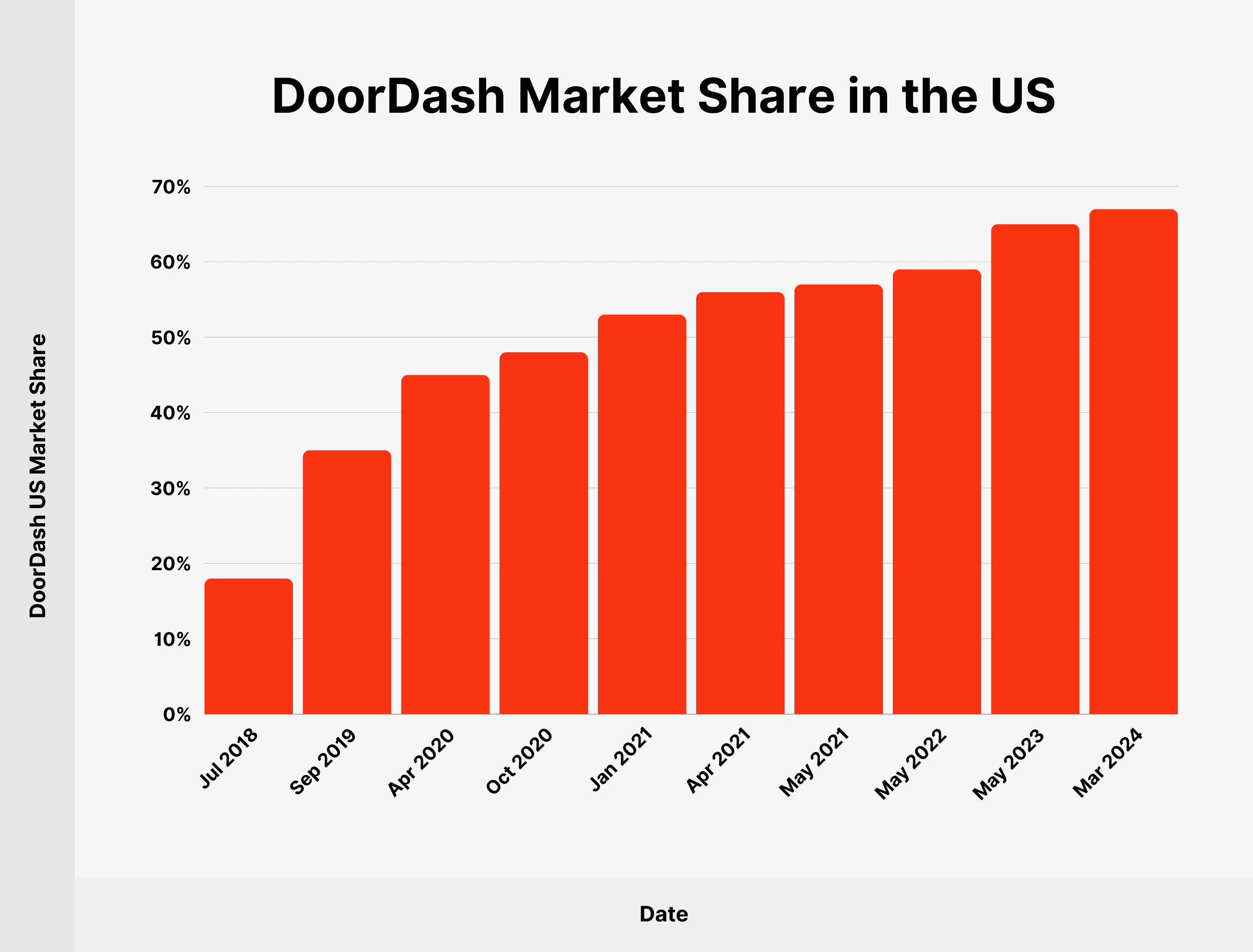
The doordash market cap stood at approximately $73.44 billion at the October 28, 2026, market close, as investors evaluated the company’s financial performance, competitive position and growth strategy. DoorDash reported strong third-quarter results on October 29, including higher revenue, increased order volume and improved net income. The company also announced a definitive agreement to acquire Instacart in a transaction valued at approximately $17 billion, introducing a significant new development for its long-term business outlook.
The latest announcements put DoorDash at an important point in its development. The company has expanded beyond restaurant delivery into grocery, retail, advertising and other local commerce services. Its proposed combination with Instacart could strengthen that strategy, although the transaction remains subject to approvals and closing conditions.
For investors and market observers, the central question is how DoorDash can translate growing marketplace activity into sustainable profitability while managing the financial and operational challenges associated with a major acquisition.
DoorDash Stock Valuation and Market Performance
DoorDash, Inc. trades on the Nasdaq stock exchange under the ticker symbol DASH. The company operates a digital marketplace connecting consumers, restaurants, retailers and delivery workers.
Its shares closed at $169.49 on October 28, 2026, giving the business an estimated market capitalization of $73.44 billion. The calculation uses the closing share price and approximately 433.3 million outstanding shares. Market capitalization can vary slightly among financial data providers because of differences in share-count calculations and reporting times.
The valuation has experienced considerable movement during 2026. At the end of 2025, DoorDash’s market capitalization was approximately $97.61 billion. By October 28, 2026, it had fallen substantially from that level.
The decline illustrates an important distinction in stock market analysis: a company’s financial performance and its stock valuation do not always move in the same direction. Investors may respond to expectations about future growth, competitive pressures, operating expenses and broader market conditions, even when a business continues reporting higher sales.
The October 28 closing figure is a reference point immediately before the company’s latest announcements. Trading following the October 29 earnings release and acquisition news may change the share price and corresponding market value.
Third-Quarter Earnings Deliver Strong Revenue Growth
DoorDash reported revenue of $4.616 billion for the third quarter ended September 30, 2026, representing a 34% increase compared with the same period a year earlier.
The results demonstrate continued demand for the company’s delivery marketplace and related services. Revenue growth was accompanied by higher order volumes and increased marketplace gross order value, indicating that customers continued to use DoorDash for a wider range of purchases.
Total orders reached 993 million during the quarter, up 28% year over year. Marketplace gross order value increased 36% to approximately $33.94 billion.
Marketplace gross order value measures the total value of orders placed through the platform under the company’s reporting methodology. It is not equivalent to revenue because DoorDash does not recognize the entire value of customer orders as its own sales.
The difference matters when evaluating the company’s scale. Gross order value provides insight into marketplace activity, while revenue measures the amount recognized by DoorDash from its business operations.
The latest results show growth across both measures, providing evidence that the company is generating more activity while increasing the revenue associated with its platform.
Net Income and Cash Generation Improve
Profitability was another important feature of DoorDash’s latest quarterly performance.
Net income attributable to DoorDash common stockholders reached $466 million, increasing 91% from the third quarter of 2025. Adjusted EBITDA rose 41% to approximately $1.06 billion.
Adjusted EBITDA is a non-GAAP financial measure that excludes certain expenses and adjustments. It can help investors assess operating performance, but it should not be treated as a replacement for net income or cash flow.
DoorDash also generated $787 million in free cash flow during the quarter, compared with $723 million in the same period last year.
Free cash flow generally measures the cash remaining after operating cash flow and capital expenditures. It is useful because a company can report accounting profits without generating an equivalent amount of available cash.
For DoorDash, stronger cash generation may provide additional flexibility to fund technology development, support business expansion and meet financial obligations. However, future cash requirements could change as the company prepares for the proposed Instacart acquisition.
The quarterly figures represent a positive operating development, but investors will need to examine subsequent results to determine whether the improvement can continue.
Instacart Acquisition Introduces a Major Growth Opportunity
DoorDash announced a definitive agreement to acquire Instacart on October 29, 2026. The transaction values Instacart at approximately $17 billion in equity value, with consideration of $65 per Instacart share.
Under the agreement, Instacart shareholders may elect to receive cash, DoorDash common stock or a combination of the two, subject to the transaction’s allocation and proration provisions. At least 75% of the total consideration is expected to be paid in cash, while DoorDash stock is limited to a maximum of 25%.
DoorDash expects to finance the cash portion using existing cash and debt financing.
The proposed transaction is targeted to close in late 2027 or the first half of 2028, subject to shareholder approvals, regulatory clearances and other customary closing conditions.
The acquisition has been announced but has not been completed. DoorDash and Instacart therefore remain separate businesses while the required steps toward closing proceed.
The agreement could reshape DoorDash’s competitive position by combining its delivery infrastructure with Instacart’s grocery technology and established relationships with retailers. Both companies have capabilities in digital ordering, delivery coordination and local commerce, although their operations and customer relationships are not identical.
If completed successfully, the transaction may create opportunities to improve merchant services, increase consumer choice and support additional delivery options.
Nevertheless, the anticipated benefits will depend on execution. Financing expenses, integration requirements, regulatory conditions and changes in consumer behavior could influence the eventual financial outcome.
Grocery and Retail Services Become More Important
DoorDash’s business strategy increasingly extends beyond restaurant orders.
Grocery and retail delivery can provide customers with more reasons to use the platform throughout the week. Instead of relying primarily on prepared meals, DoorDash can serve demand for household essentials, packaged foods, personal care products and other merchandise.
During the third quarter of 2026, U.S. grocery and retail marketplace gross order value grew at more than twice the rate of the U.S. restaurant category.
That performance highlights the importance of developing services across multiple shopping occasions. A broader selection can potentially increase customer engagement and provide merchants with additional sales channels.
Instacart’s business could complement this approach by adding established grocery technology and retailer connections. Its capabilities may help DoorDash strengthen its position in a market where consumers increasingly expect convenient digital ordering and flexible fulfillment options.
However, grocery delivery presents its own operational challenges. Product availability, substitutions, delivery timing, picking costs and retailer economics can affect customer satisfaction and profitability.
DoorDash will need to manage these factors carefully if it intends to turn greater grocery activity into durable financial returns.
Competition Remains a Key Valuation Factor
DoorDash operates in a competitive industry that includes other delivery platforms, restaurant-owned ordering systems, grocery services and retailers offering their own fulfillment arrangements.
Competition affects several aspects of the business. Delivery companies must attract consumers, maintain reliable service, retain merchants and provide attractive economics for delivery workers. They also need to invest in technology and customer support while managing operating expenses.
Customer promotions and membership benefits may encourage repeat usage, but they can also affect profitability. Merchant commissions and delivery fees must be balanced against the costs of providing the service and maintaining competitive pricing.
DoorDash’s membership programs, including DashPass, are designed to encourage recurring engagement. Its advertising and merchant services also provide opportunities to generate revenue beyond basic delivery transactions.
The company’s international operations, including Wolt and Deliveroo, add geographic reach but also expose the business to different competitive conditions and operating requirements.
These factors help explain why strong revenue growth alone cannot determine whether the stock is attractively valued. Investors must also assess the company’s ability to protect margins and generate consistent cash flow as competition evolves.
Understanding Market Capitalization and Enterprise Value
Market capitalization measures the market value of a company’s outstanding equity. It is calculated by multiplying the share price by the number of shares outstanding.
Using DoorDash’s October 28 closing data, the calculation was approximately $73.44 billion.
Enterprise value provides a different perspective. It generally incorporates market capitalization, debt and certain other claims while subtracting cash and cash equivalents, depending on the calculation methodology.
One financial data provider estimated DoorDash’s enterprise value at approximately $71.40 billion using its October 28 figures.
The two measurements serve different purposes. Market capitalization is useful when examining the value assigned to a company’s publicly traded shares. Enterprise value can be more helpful when comparing businesses with different debt and cash positions.
The proposed Instacart acquisition adds another reason to monitor these measures. Debt financing and any stock issued as part of the transaction could influence DoorDash’s future capital structure.
The acquisition’s announced equity value should not simply be added to DoorDash’s existing market capitalization to calculate a combined valuation. A proper assessment would require consideration of the transaction structure, financing, ownership, cash, debt and the market value of the resulting business.
What Could Influence DoorDash’s Valuation Next
Several developments will help shape investor assessments of DoorDash in the coming quarters.
Revenue and order growth will remain important indicators of marketplace demand. Investors will also examine whether the company can sustain improvements in net income, adjusted EBITDA and free cash flow.
The progress of the Instacart transaction is another central consideration. Regulatory review, shareholder approvals, financing arrangements and integration planning may affect expectations before the proposed closing date.
Changes in consumer spending could also influence demand. Delivery services compete for household budgets, and customers may adjust their ordering frequency or spending when economic conditions change.
Operating costs deserve close attention as well. Delivery incentives, customer acquisition, technology investment and merchant support can affect margins. The company must balance growth initiatives against the need to generate sustainable returns.
Finally, stock market conditions and investor expectations may cause DoorDash shares to fluctuate independently of its near-term operating results. A strong earnings report does not guarantee a rising share price, just as a declining valuation does not necessarily mean the underlying business is deteriorating.
Outlook for DoorDash in 2026 and Beyond
DoorDash’s latest quarterly results demonstrate substantial growth in revenue, marketplace activity and net income. The company is also pursuing a major strategic transaction that could expand its grocery and retail capabilities.
Its approximately $73.44 billion market capitalization at the October 28 close reflects the market’s valuation before the October 29 announcements. Subsequent trading may provide a different assessment as investors consider both the earnings results and the proposed Instacart acquisition.
The transaction offers a potential path toward a larger local commerce platform, but it also introduces financing, regulatory and integration risks. Its eventual effect will depend on the terms at closing and the combined business’s ability to deliver measurable operating benefits.
For investors following DoorDash, the most useful approach is to evaluate its market value alongside revenue growth, profitability, cash generation, competitive positioning and acquisition progress.
DoorDash has demonstrated that its marketplace can continue expanding. The next challenge is to maintain that momentum while ensuring that growth translates into sustainable financial performance.
Share your thoughts in the comments and stay updated on the latest DoorDash stock, valuation, earnings and acquisition developments.