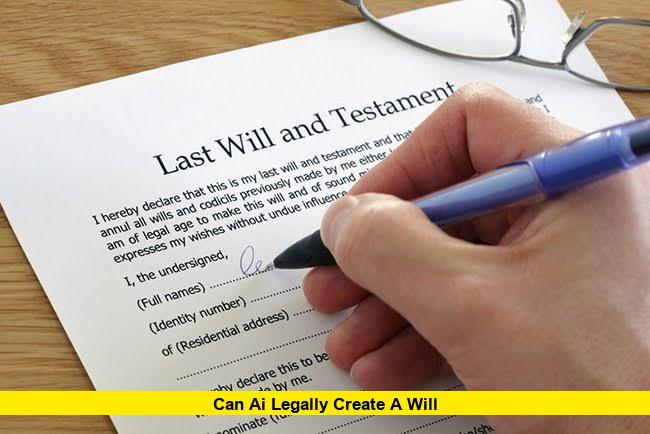
A will typed by a chatbot can look finished. It can name heirs, appoint an executor, and read like something a courthouse would accept. That appearance is why the question Can AI Legally Create a Will has moved from tech forums into probate offices. The legal test has not moved with it. In the United States and in England and Wales, judges still ask whether the person had capacity, whether the document shows real intention, and whether the signing rules were followed. The tool that produced the sentences is not the deciding fact.
Public confidence is running ahead of the statute book
National polling this year found that 30 percent of Americans now trust machine advice on estate planning more than a lawyer’s advice, up 10 points in twelve months. Among the youngest adults the share is 46 percent. Only 5 percent would sign an estate document with no professional review.
In Britain, a 2026 industry survey found that 72 percent of adults in their early thirties would consider letting software write a will. Practitioners reported a different number. Fifteen percent had already seen drafting errors tied to automated text, and 7 percent had seen a will fail after the family relied on it.
Those two pictures can sit together. People are willing to start with software. Courts are not willing to skip the old ceremony.
Formalities still do the legal work
No American state has passed a rule that throws out a will only because software wrote it. As of September 2026, no federal appeals court has done that either. Contests still turn on capacity, proper execution, undue influence, fraud, or a failure to know and approve the contents.
Most states still want a written document, the maker’s signature, and two witnesses at the signing. Louisiana often adds a notary. A handful of states still honor a fully handwritten will if the handwriting and signature rules are met. Vermont’s traditional practice has asked for three witnesses. A form that clears one state can collapse in the next.
England and Wales remain under the Wills Act 1837. The paper must be signed by the maker, or by someone else at the maker’s direction and in the maker’s presence, and two witnesses must be present together and must sign. Software can produce text that later meets that test. Meeting the test is not the same as fitting a blended family, a business, a vulnerable heir, or a tax problem.
Paper is still the default, with a short digital list
Fully electronic wills exist only in a minority of American jurisdictions. The list includes Arizona, Colorado, Florida, Idaho, Illinois, Indiana, Maryland, Minnesota, Missouri, Nevada, North Dakota, Oklahoma, Utah, Washington, and the District of Columbia. Each statute sets its own rules on remote witnesses, notaries, and storage. New York passed an electronic-will law in December 2025, but it does not take effect until December 12, 2027, and an electronic will there must be filed with the court system within 30 days or it fails.
Everywhere else, a chatbot file has to be printed and signed on paper in front of the witnesses the state requires. A digital draft does not become an electronic will just because it never left the screen.
The damage shows up after the funeral
That timing is the hard part. A missing residuary clause, a gift that skips a required heir, or a witness who stood to benefit may sit unnoticed for years. Once the maker has died, nobody can clarify what was meant. If the new document is admitted and then fails, it may already have canceled an older valid will. The estate then falls under intestacy, a default map that often leaves out unmarried partners and stepchildren.
Ambiguous gifts are another flashpoint. “Knowledge and approval” claims grow when people sign machine text they never really read. The signature can be real while the family still cannot agree on what the maker understood.
Tax language is a quiet failure point in 2026. The federal estate-tax exemption reset this year to about $15 million per person, with inflation indexing. Several states still impose their own estate or inheritance taxes at much lower thresholds. Generic drafts have misstated both sets of numbers and skipped clauses that decide who bears the bill.
Chats are not confidential
A February 2026 ruling in federal court in New York settled a point long argued in client meetings. Messages with a public chatbot are not attorney-client privileged, and they are not work product. The user was not talking to a lawyer. The consumer product’s terms allowed the company to disclose data. Handing those chats to a lawyer later did not pull them back under privilege.
Notes about cutting out a relative, unequal gifts, or a fight over a house can become ordinary records. In a later contest, those records can be requested. Identifying details and family conflict do not belong in a public tool.
Vendors disclaim legal fitness. If the document fails, the fee paid for the tool is often the only number on the table. The litigation cost lands on the estate.
What a newsroom can say with confidence
Can AI Legally Create a Will is a fair headline and a narrow legal answer. The software may draft. The law still demands a capable maker, a document that person knew and approved, and a signing that matches the place where the will must work. No special ban exists. No special pass exists either.
The working pattern this autumn is modest. People use the tools to learn terms, list assets, and prepare questions. They do not treat the printout as final. A licensed lawyer in the relevant jurisdiction revises the text and supervises the signing. Template platforms built by attorneys are a separate product from an open chatbot, and even those platforms still leave execution to the user.
For a tiny estate with a straightforward family, a carefully executed draft can hold. For a house, a business, minor children, a prior marriage, or a tax exposure, the savings on the draft are small next to a contest that cannot be fixed. The statute book has not caught the software. Probate court has not agreed to look the other way.