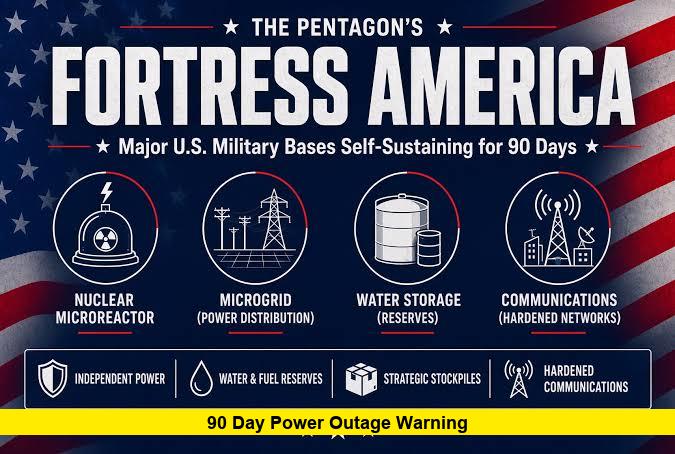
If you searched for a 90 day power outage warning when does it start, the direct answer is that no such outage or official household warning has been announced or scheduled by any U.S. federal agency, utility, or grid operator. No start date exists because no nationwide or multi-month civilian blackout has been planned or forecasted.
Social media posts and viral videos have turned a Pentagon military readiness initiative into claims of an imminent 90-day shutdown of power to American homes. Those claims are not supported by official sources. The 90-day figure applies to military bases in a contingency scenario, not to the public grid.
Where the 90-Day Number Actually Comes From
Defense Secretary Pete Hegseth announced the FORTRESS America initiative on September 30, 2026. The program (Federal Operations for Resilience, Troop Resources, Energy, Supply, and Survivability) aims to reduce the military’s dependence on civilian infrastructure.
Reporting based on internal planning documents, including a Fox News Digital account published October 25, 2026, described a goal for major military installations in the continental United States to sustain essential operations for at least 90 days without outside electricity, water, fuel, or supplies. The Pentagon has not publicly released a final directive confirming every detail of that 90-day standard, and officials have indicated that fully achieving the broader goals could take years or longer. Pentagon spokesperson Sean Parnell has said the military does not want national defense to depend on ordinary civilian utilities, describing that reliance as an intolerable risk in a major conflict scenario.
The plan focuses on microgrids, battery storage, and other on-base power solutions so bases can continue operating if the civilian grid is disrupted. It does not direct or predict any cutoff of power to homes, businesses, or the general public.
No Date Has Been Set Because No Outage Has Been Announced
There is no start date for a 90-day power outage because no agency has issued a warning of one. Fact-checks, including from Snopes, have found no official announcement of a planned civilian grid shutdown lasting 90 days or any other extended period. Videos circulating in early November 2026 that appeared to show President Trump announcing a 90-day blackout were created with AI manipulation of real footage and were rated Fake by Snopes. Those clips often promoted cryptocurrency tokens and do not reflect any actual statement by the president or the White House.
Long power outages do occur in the United States after major storms, equipment failures, or other events, but typical interruptions are far shorter. Official guidance has not changed in response to the Pentagon program.
The November 17 Emergency Alert System Test Is Unrelated
FEMA and the FCC have scheduled a nationwide test of the Emergency Alert System for Tuesday, November 17, 2026, at approximately 2:20 p.m. Eastern Time. The test will interrupt programming on television, radio, cable, and satellite with a message stating that it is only a test and that no action is required by the public. A backup date of December 3, 2026, is available if needed. This is a routine, legally required exercise of the broadcast alert system and does not involve wireless alerts to cell phones. It has no connection to any power outage.
Details are available from the FEMA announcement and the FCC public notice.
What Official Preparedness Guidance Actually Says
Federal recommendations for households remain focused on shorter disruptions:
- Ready.gov advises being prepared to manage on your own for several days with food, water, and basic supplies.
- The CDC recommends storing at least one gallon of water per person per day and trying for a two-week supply if possible.
- The American Red Cross suggests about two weeks of food and water for home.
These guidelines have not been updated to call for 90 days of supplies in response to the military initiative. Most U.S. power outages last hours to a few days, though severe weather can produce longer regional interruptions depending on location and damage.
You can review current federal advice at the Ready.gov power outage page.
Practical Steps for Real Outages
While no 90-day event is scheduled, ordinary preparedness remains useful for the outages that do happen from storms, ice, high winds, or equipment issues. Key actions include:
- Store one gallon of water per person per day for drinking and basic sanitation. Aim first for several days, then expand toward two weeks if space allows.
- Keep non-perishable food, a manual can opener, flashlights, extra batteries, and a battery or hand-crank radio.
- Know that a refrigerator generally keeps food cold for about four hours and a full freezer for about 48 hours if the doors stay closed. Discard food that has been above 40°F for more than two hours.
- If you use a generator, operate it outdoors only, at least 20 feet from the house, with exhaust pointed away from windows and doors. Never run one in a garage or indoors. Install carbon monoxide alarms with battery backup.
- Have a plan for refrigerated medications and powered medical devices. Contact your provider or pharmacy if an outage lasts more than a day.
- Keep some cash on hand and know how to receive local alerts from your utility and emergency management office.
Outage length varies significantly by region. Coastal and Gulf states face longer restoration times after hurricanes, northern areas after ice storms and heavy snow, and western states after wildfires or extreme heat that stresses the grid. Check your local utility’s outage map and sign up for alerts for the most accurate local information.
What Readers Should Watch Next
The Pentagon continues work on base energy independence under FORTRESS America, with assessments covering hundreds of installations and some microgrid and microreactor projects already underway. No public timeline indicates an imminent civilian impact. The November 17 EAS test will proceed as a scheduled exercise unless postponed for an actual emergency.
Grid operators and the Department of Energy continue routine reliability work, including occasional emergency orders to keep certain plants online during high-demand periods. Those measures are temporary and unrelated to any multi-month national outage.
Share your local experiences with power outages or preparedness tips in the comments, and stay updated with official sources as more information develops.