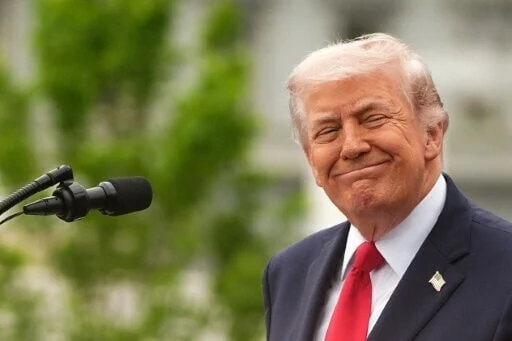
For the first time in U.S. history, a sitting president’s portrait is being placed inside an American passport. The State Department confirmed Tuesday that it is preparing to release a limited series of specially designed travel documents featuring President Donald Trump’s face, framed as part of the country’s 250th anniversary celebrations. The move to start putting Trump’s face on the passport has ignited a firestorm of public debate — raising serious questions about the boundary between patriotism and self-promotion, between commemoration and vanity.
This is not a rumor or a political attack. It is a confirmed government action. The new passport design features Trump’s second inaugural portrait superimposed over the text of the Declaration of Independence, paired with his signature rendered in gold lettering. A separate page is expected to display the famous John Trumbull painting of the Founding Fathers signing that same document — a juxtaposition that has not gone unnoticed by critics or supporters alike.
Want to stay ahead of the biggest political stories shaping America right now? Bookmark this page and keep reading for full analysis.
What the New Passport Actually Looks Like
According to the State Department spokesperson Tommy Pigott, the new design shows the president’s image superimposed over the Declaration of Independence and an American flag, with Trump’s signature appearing in gold lettering. A famous painting of the Founding Fathers signing the Declaration of Independence will be featured on a separate page inside the document.
As per reports from multiple news outlets including NBC News and CNN, the current inside front cover of U.S. passports features a painting of Francis Scott Key the morning after the bombardment of Fort McHenry — the battle that inspired Key to write what would become the national anthem — with lines from the anthem printed alongside it.
The new design represents a significant aesthetic and symbolic departure from that tradition — swapping a historical, event-based illustration for the portrait of a living, sitting president.
A “Limited Edition” With Major Reach
According to the State Department, the passports will begin rolling out this summer. As per a State Department official who spoke to CNN, the special edition passport will serve as the default document issued out of the Washington Passport Agency while supplies last, while online renewals and applications at other locations will continue using the existing design.
That detail is significant. While the administration has framed this as a collectible or commemorative product, making it the automatic default for in-person renewals in Washington, D.C., means that many Americans — without actively choosing to do so — could end up carrying the president’s face across international borders.
According to The Bulwark, which first reported the story citing two sources with direct knowledge of the redesign, the State Department is planning a limited run of 25,000 Trump-emblazoned passports. Whether that number stays fixed, expands, or sets a precedent for future designs remains an open question.
First Time in American History
Let that sink in for a moment: no sitting president has ever appeared as a standalone portrait in a U.S. passport. According to reporting by The New Republic and multiple political analysts, while the current U.S. passport already includes an image of Mount Rushmore — which features the carved faces of four former presidents — this would mark the first time a solo portrait of any U.S. president, living or deceased, has appeared inside the document.
As per CNN’s reporting, unlike a commemorative coin or a national park pass, a U.S. passport is an internationally recognized form of identification that is typically valid for ten years.
That ten-year lifespan matters enormously. An American who renews their passport this summer under the new design will be carrying Donald Trump’s portrait on their person in every country they visit until 2036 — regardless of who occupies the White House by then, regardless of how history judges his presidency, and regardless of whether the passport holder ever voted for him.
The 250th Anniversary Framing
The administration has anchored the passport redesign to America’s semiquincentennial — the 250th anniversary of U.S. independence in July 2026. According to a statement from White House spokesperson Olivia Wales, Trump’s new passport design provides “yet another great way Americans can join in the spectacular celebrations for America’s 250th birthday,” adding that the president “continues to proudly lead a renewal of national pride and patriotism during our historic semiquincentennial celebration.”
This framing has been used repeatedly across multiple initiatives. As per reporting by CNN and NBC News, the Department of the Interior previously announced commemorative new designs for national park passes — one of which features Trump’s face alongside George Washington. Around the same time, Trump’s handpicked Commission of Fine Arts voted to approve a commemorative coin for the 250th birthday featuring the president’s likeness.
The pattern is impossible to miss. The semiquincentennial has become the administrative vehicle through which Trump’s image is being attached to official government documents and items that Americans will use and carry for years to come.
A Broader Pattern of Self-Branding
The passport announcement does not exist in isolation. It is the latest — and arguably the most consequential — step in a second-term strategy of institutional self-branding.
According to The Bulwark’s investigative reporting, during his second term Trump has taken aggressive steps to attach his name and likeness to a wide range of government properties. His signature is set to appear on future U.S. currency. Large banners bearing his face have appeared on federal buildings. A prescription drug website called TrumpRx.gov was created under his administration. A new “Trump class” of battleships has been announced, and his name has been formally placed on both the U.S. Institute of Peace and the John F. Kennedy Memorial Center for the Performing Arts.
As per Commerce Secretary Howard Lutnick, Trump also introduced the “Trump Gold Card” and “Trump Platinum Card” — immigration residency fast-track programs priced at $1 million and $5 million respectively — though Lutnick acknowledged that only one person had successfully purchased a card as of his most recent public statement.
Each of these moves, taken on its own, might be written off as political posturing. Taken together, they form a coherent and deliberate rebranding of the federal government — one in which the president’s identity becomes increasingly inseparable from the institutions of the state.
How Does This Compare to Other Countries?
It is worth examining how other nations handle the question of leadership imagery in official travel documents. Authoritarian governments and monarchies have long featured their leaders on currency, passports, and official seals. Democratic governments operate very differently.
According to analysts and international observers cited across multiple outlets, no foreign democratic nation currently includes a portrait of its sitting head of state inside its passports. That is not a coincidence. It reflects a long-standing international norm that travel documents belong to the citizen — not to the government, and certainly not to the individual who happens to lead it at any given moment.
The United States has historically prided itself on a government of, by, and for the people. A passport bearing the face of a sitting president — especially one with such a polarizing public profile — challenges that tradition in a visible, tangible, and internationally broadcast way.
The Reaction: Critics, Supporters, and Everything In Between
Public reaction has been swift and sharply divided.
According to his post on X, Democratic California Congressman Mike Levin called out the fact that Trump’s signature was placed directly over the Declaration of Independence — a document, Levin noted, that was “literally written to get away from this exact behavior.” As per Levin’s statement, “No sitting president has ever done this. Coins, park passes, battleships, and now your passport. The man cannot find a surface he will not slap his name or face on. This is not patriotism. It is vanity.”
According to posts circulating widely on social media, the president’s niece Mary Trump also weighed in, writing: “I’ve never been so relieved to have already renewed my passport.”
Supporters, on the other hand, have welcomed the design as a bold celebration of American strength and a fitting tribute to a president they see as having revitalized national pride. As per the White House, the moment is part of a broader cultural renewal tied to the country’s 250th birthday — one that the administration says reflects a genuine recommitment to American identity and patriotism.
Analysis: What This Moment Actually Represents
Here is the honest assessment: placing a living president’s face on an internationally recognized travel document is an act without modern democratic precedent. The 250th anniversary framing provides a ceremonial wrapper — but it does not fully explain why the commemoration of American independence requires the specific likeness of the individual currently in power, rather than imagery tied to the nation’s founding, its people, or its broader history.
There is a meaningful difference between celebrating a country and celebrating its leader. The Declaration of Independence placed front and center in the design is a document born from the rejection of concentrated personal authority. Pairing it with the gold-signed portrait of a sitting president is — at minimum — a striking visual paradox that historians and constitutional scholars are likely to debate for years.
That does not mean every criticism of the design is automatically valid. There is a legitimate argument that commemorative editions of official documents have always blended national history with the personalities of their era. Presidential imagery on currency, for example, is deeply embedded in American tradition — even if it has historically applied only to presidents no longer living.
But a passport is different from a dollar bill. It is the document you hand to a foreign customs officer. It is the credential that identifies you, as an American, to the rest of the world. For the next decade, that credential will carry the face of one man — and that man’s tenure will end long before most of those passports expire.
What Happens Next
The State Department has confirmed the passports will be issued beginning this summer. According to a State Department official who spoke to multiple outlets, anyone renewing their passport in person at the Washington Passport Agency will receive the new design by default. Those who prefer the standard version will reportedly be able to request it.
As per polling data cited in reports following the Treasury’s March announcement about Trump’s image on U.S. currency, most Americans oppose placing a sitting president’s likeness on official government documents. Whether that opposition applies equally to the passport design — or whether the anniversary framing softens public resistance — remains to be seen.
What is certain is that this decision will shape how millions of Americans are represented at border crossings, airports, and consulates around the world for the next decade.
The decision to start putting Trump’s face on the U.S. passport may be framed as a celebration of 250 years of American independence. But the debate it has ignited is really about something deeper: who a passport belongs to, what it says about a nation, and whether a democratic government should ever look — even slightly — like one built around a single person.
Follow this page and share your thoughts below — do you think the new passport design honors American history, or does it cross a line? Drop your comment and let us know where you stand.
The face on your passport may change with administrations — but the question of who owns America’s national identity belongs to every citizen. Sound off below.