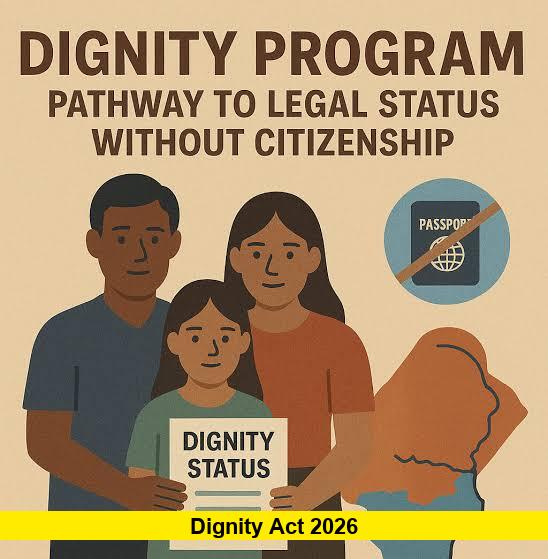
The Dignity Act 2026 push is gaining ground in Washington, but the bill remains a proposal and offers no application process today. Rep. María Elvira Salazar, R-Fla., announced on Nov. 16, 2026 that 16 more House members had joined the measure, lifting support to 56 lawmakers. The bill has not passed the House or the Senate. Here is what it would do, who backs it, who opposes it, and what could happen next.
The bill’s formal number is H.R. 4393, and its formal name is the DIGNIDAD (Dignity) Act of 2025. It was introduced in the 119th Congress, so the 2026 label reflects this year’s surge in support rather than a new bill.
What Is the Dignity Act?
Salazar and Rep. Veronica Escobar, D-Texas, introduced the bill on July 15, 2025. The full title is the Dignity for Immigrants while Guarding our Nation to Ignite and Deliver the American Dream Act. It grew out of Salazar’s “Dignity Plan,” which she announced in March 2021, and it updates earlier versions of the bill. You can read the full bill text on GovInfo.
The sponsors describe five core goals:
- Ending illegal immigration
- Fixing the asylum system
- Giving long-term undocumented immigrants a path to legal status
- Protecting American workers
- Modernizing legal immigration
Latest Dignity Act Developments
Support has climbed from 35 lawmakers at the start of 2026 to 56 in November. The latest additions include one Republican, Rep. Carlos Gimenez of Florida, and 15 Democrats. About 20 Republicans now back the bill.
The momentum builds on earlier milestones. The Problem Solvers Caucus endorsed the bill on May 12, 2026. At that point the sponsors counted 40 House members and more than 95 national organizations in support.
Salazar announced the new cosponsors just days after winning a narrow reelection in Miami following a recount. She has also pushed back on the White House. In September, she ran a campaign ad warning that some enforcement efforts had gone too far.
The fight over labels heated up this week. Oklahoma Gov. Kevin Stitt argued on Nov. 25 that the word “amnesty” shuts down the immigration debate. Salazar agreed on Nov. 26 and called the term a “cheap word trick.”
Where H.R. 4393 Stands in Congress Right Now
The bill is active but stalled. It was referred to several House committees, including a subcommittee on border security and enforcement. It has not passed the House, and no Senate version has moved.
Time is also a factor. The 119th Congress ends on Jan. 3, 2027, and bills that have not passed die with it. Supporters would need to reintroduce the measure in the 120th Congress. The sponsors have not announced a reintroduction date.
Anyone tracking the bill can follow its official status on Congress.gov.
What the Dignity Program Would Do
The bill’s centerpiece is the Dignity Program for undocumented immigrants who have lived in the U.S. since before Dec. 31, 2020. The sponsors’ official summary of the bill outlines the main requirements. Participants would need to:
- Pass a criminal background check
- Pay back taxes and begin paying income taxes
- Pay $7,000 in restitution over seven years
- Check in with the Department of Homeland Security every two years
- Follow all federal and state laws
After completing the program, participants could apply for Dignity Status. It would bring protection from deportation, full work authorization, and permission to travel abroad. Dignity Status could be renewed indefinitely for people who stay in good standing.
The bill would not create a path to a green card or citizenship through this program. Participants would also stay ineligible for federal means-tested benefits. Some news coverage describes the bill as a pathway to citizenship, but the sponsors’ summary and a Greenberg Traurig legal analysis both say the Dignity Program excludes it.
How the Bill Would Be Funded
The sponsors say no taxpayer money would pay for the bill. A 1% levy on the paychecks of work-authorized participants would fund border and processing costs. Any surplus would pay down at least $50 billion of the national debt.
Restitution payments would also fund an American Worker Fund for training and apprenticeships. The sponsors say it would total at least $70 billion. These figures are the sponsors’ own projections.
Border Security, E-Verify and Asylum Changes
Supporters stress that the bill pairs legal status with enforcement. Its border and workplace provisions include:
- Mandatory nationwide E-Verify for all employers, phased in by company size
- More physical barriers and technology at the border
- Higher pay for Border Patrol agents, including a raise of at least 14% at the GS-12 level
- At least three Humanitarian Campuses to process asylum seekers who arrive at the southern border
- Asylum decisions within 60 days, with a credible fear interview within 15 days
- A two-strike policy for people caught crossing between ports of entry
- Tougher penalties for human traffickers and asylum fraud
Dreamers, Visa Backlogs and Legal Immigration
The bill would give Dreamers and DACA recipients conditional permanent resident status for 10 years. They could then move toward a green card through work, military service, or higher education.
It would also change the legal immigration system. Key changes include:
- A $20,000 premium fee that lets people waiting 10 years or more for a family or employment visa receive it
- A higher per-country visa cap, raised from 7% to 15%
- An O visa option for U.S. STEM PhD graduates
- A new 90-day family visitor visa
- Protection for children who would otherwise age out of visa eligibility
Who Supports the Dignity Act and Who Opposes It
Backers span both parties and several states. Republican supporters include Reps. Mike Lawler of New York, David Valadao of California, Don Bacon of Nebraska, Brian Fitzpatrick of Pennsylvania, and Mario Díaz-Balart of Florida. Democratic supporters include Reps. Henry Cuellar of Texas and Adriano Espaillat of New York. The U.S. Chamber of Commerce and the Essential Worker Immigration Coalition have also endorsed the bill.
Opposition comes mostly from within Salazar’s own party. Rep. Brandon Gill, R-Texas, has called the bill amnesty and a betrayal of Republican voters. Conservative commentators argue that legalization encourages more illegal immigration. They point to the 1986 immigration law as their example.
Vice President JD Vance weighed in on Nov. 4, after the midterm elections. He warned that Republicans pushing amnesty were misleading voters, though he said he was open to focusing enforcement on employers who hire undocumented workers. Trump, meanwhile, has signaled interest in a broader deal with Democrats, though no agreement has been announced.
What the Bill Would Not Do
Several misconceptions are circulating online, so a few facts are worth stating plainly:
- The bill is not law. No one can apply for Dignity Status today.
- It does not cover recent arrivals. The residency cutoff is Dec. 31, 2020.
- It does not offer federal benefits to program participants.
- It does not guarantee passage. The bill still needs to clear committees, the House, and the Senate.
What Happens Next for the Dignity Act
Several things are worth watching in the coming weeks and months:
- Reintroduction. Watch whether Salazar and Escobar refile the bill when the 120th Congress convenes in January 2027.
- Cosponsor count. A rising tally would show whether the momentum is real.
- White House talks. Any Trump-Democrat negotiation could pull parts of the bill into a different package.
- Narrower bills. Legal analysts note that individual pieces, such as the workforce provisions, may have better odds than the full package.
What Readers Should Do Now
Treat any offer of “Dignity Act” paperwork as a scam. No agency is accepting applications. Immigrants with questions about their situation should consult a licensed immigration attorney or an accredited nonprofit representative.
Employers should watch for any mandatory E-Verify provision, but there is nothing to implement now. Readers who want to weigh in can contact their member of Congress through the House’s Find Your Representative tool. A short message naming H.R. 4393 is enough.
Do you think Congress can finally find common ground on immigration reform in 2027? Share your thoughts in the comments and check back for the latest Dignity Act updates.