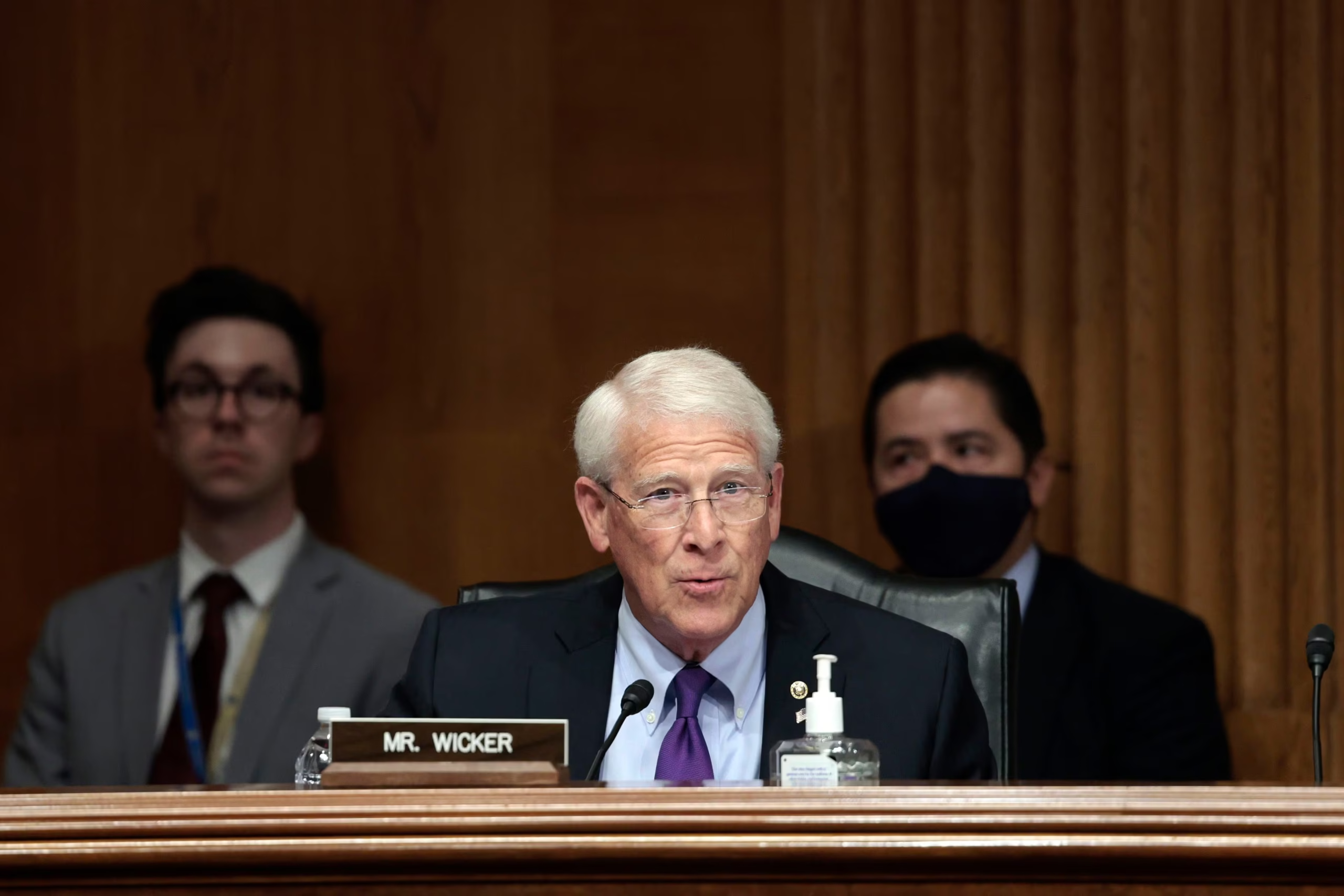
Senators have approved a sweeping new national defense policy bill that authorizes roughly 901 billion dollars in national security spending for fiscal year 2026, sending the measure to President Donald Trump’s desk after a strong bipartisan vote. The move caps months of negotiations over America’s military posture, Pentagon reforms, support for allies, and hot‑button social issues as the latest defense bill senate debate comes to a close.
Massive price tag and bipartisan vote
The Senate passed the National Defense Authorization Act (NDAA) on a 77–20 vote, following earlier House approval by a 312–112 margin. Together, the votes underscore broad bipartisan agreement that the Pentagon needs more resources to modernize and respond to growing threats, even as lawmakers sparred over policy riders attached to the bill. The final package authorizes about 900.6 billion dollars for national security programs, including the Defense Department, nuclear weapons activities at the Department of Energy, and related accounts.
The authorized total sits roughly 8 billion dollars above the Trump administration’s original budget proposal for the Pentagon and associated national security programs. Lawmakers framed the increase as necessary to accelerate shipbuilding, strengthen the munitions industrial base, and invest in new technologies that are central to deterrence in Europe and the Indo‑Pacific. However, the measure remains a policy authorization; Congress will still need to pass separate full‑year appropriations to actually deliver the funds to the Pentagon.
Key pay and personnel changes
Service members are set to receive a pay raise of about 3.8 to 4 percent under the new NDAA, continuing a trend of compensation increases aimed at helping troops cope with inflation and retaining skilled personnel. Lawmakers also signed off on expanded recruitment bonuses and incentives to attract new volunteers into the force, responding to persistent recruiting challenges across several branches.
The bill includes a mix of quality‑of‑life measures and controversial cutbacks. While it adds select new benefits and targets outdated or duplicative Pentagon programs for elimination, it also trims or rolls back some initiatives related to diversity, equity, and inclusion, as well as other personnel‑related policies that had been embraced in recent years. Supporters argue that these changes refocus the military on readiness and war‑fighting, while critics warn they risk undermining morale and recruitment in an increasingly diverse force.
Major boost for shipbuilding and munitions
A central feature of the legislation is a significant boost for the defense industrial base, particularly in shipbuilding and critical munitions. The NDAA authorizes about 26 billion dollars for shipbuilding, funding construction and support for major programs such as Columbia‑class ballistic missile submarines, Virginia‑class attack submarines, Arleigh Burke‑class destroyers, and other key vessels. Lawmakers see these investments as vital for maintaining U.S. naval dominance and meeting the demands of deterrence in the Indo‑Pacific.
On the munitions side, the bill authorizes more than 25 billion dollars to purchase and replenish critical weapons ranging from Tomahawk cruise missiles and Naval Strike Missiles to Javelin anti‑tank weapons and advanced air‑to‑air missiles. Members of Congress have repeatedly highlighted gaps in U.S. and allied stockpiles after recent conflicts and have pressed the Pentagon to secure long‑term production contracts to encourage industry to expand capacity. The NDAA authorizes multiyear procurement authority for key munitions, giving companies more certainty to invest in new lines and facilities.
Sweeping acquisition and budgeting reforms
Beyond the topline funding numbers, the NDAA aims to reshape how the Pentagon buys weapons and manages major programs. The bill requires the Defense Department to adopt a “portfolio acquisition executive” model for key mission areas, consolidating oversight of related systems under a single manager with authority to shift resources among programs. Proponents believe this shift will speed delivery of capabilities, reduce bureaucratic delays, and help avoid the cost overruns that have dogged past acquisitions.
The legislation also seeks to open the door wider to commercial and non‑traditional defense firms by easing certain contracting rules and emphasizing speed of delivery, innovation, and production capacity in acquisition decisions. Lawmakers want the Pentagon to move faster in fields such as drones, software, and space systems, where commercial technology often advances more quickly than traditional defense procurement cycles. At the same time, the bill preserves congressional oversight, with new reporting requirements designed to keep lawmakers informed about how acquisition reforms are implemented.
Focus on Europe, Ukraine, and Indo‑Pacific partners
The new NDAA reinforces U.S. commitments to NATO and European allies while continuing support for Ukraine’s defense against Russia. The measure authorizes about 400 million dollars for Pentagon efforts to arm and equip Ukraine’s military, including ongoing training and assistance programs. It also includes language designed to strengthen deterrence against Russia, preserve U.S. troop levels in key areas, and maintain a robust American presence in Europe.
At the same time, the bill expands initiatives in the Indo‑Pacific region, with an emphasis on bolstering Taiwan’s defense and enhancing cooperation with key allies and partners. The legislation supports investments in missile defenses, maritime domain awareness, and logistics networks that would be essential in any regional crisis. Senior lawmakers have described these measures as part of a broader effort to manage simultaneous challenges from Russia and China without overstretching U.S. forces.
New limits on presidential war powers
One notable provision in the bill responds to long‑standing concerns over expansive presidential war powers. The agreement includes the repeal of the 1991 and 2002 authorizations for the use of military force in Iraq, legal authorities that multiple administrations have used or cited even decades after the original conflicts. Critics of those authorizations have argued that leaving them on the books gave presidents too much unilateral leeway to launch or expand military operations without updated congressional approval.
By rescinding those authorizations, Congress is signaling a desire to reassert its constitutional role in decisions over war and peace. Lawmakers and advocates have spent years pushing for this step, noting that the original conflicts have long since ended and that any new large‑scale military action should be explicitly debated and authorized. The NDAA does not strip the president of all existing authority to respond to emergencies or imminent threats, but it narrows the legacy statutes that have formed a legal backdrop for many deployments.
Hot‑button social and cultural provisions
In addition to its core national security components, the NDAA carries several social and cultural policy changes that sparked intense debate. The measure codifies a number of President Trump’s executive orders related to the Pentagon, embedding them into law rather than leaving them solely as administrative directives. It also rolls back or eliminates certain diversity, equity, and inclusion programs within the Defense Department, and tightens rules on other personnel policies.
Some lawmakers celebrated these moves as a course correction, arguing that they remove distractions from the military’s primary mission and align policy more closely with the current administration’s priorities. Others warned that the changes could harm recruitment, retention, and readiness by alienating segments of the force and reducing support for underrepresented groups. These debates are likely to continue in future defense bills, as both parties test how far they can push social policy through must‑pass national security legislation.
Guardrails, cuts, and efficiency pushes
The bill attempts to pair new investments with efforts to cut waste and streamline the Pentagon’s vast bureaucracy. It calls for eliminating billions of dollars’ worth of obsolete weapons systems, inefficient programs, and redundant offices, with the goal of freeing up resources for higher‑priority needs. The legislation also adds “guardrails” around certain long‑term investments, seeking to protect key modernization projects and industrial‑base initiatives from future budget swings.
At the same time, lawmakers built in enhanced oversight mechanisms for some of the most expensive programs. The NDAA requires regular briefings and reports on acquisition reforms, shipbuilding timelines, space capabilities, and other complex efforts that have historically faced delays or overruns. These provisions reflect a balancing act between giving the Pentagon more flexibility and ensuring that Congress can still monitor how taxpayer dollars are used.
Defense of the homeland and emerging threats
Recognizing evolving security challenges, the NDAA places renewed emphasis on counter‑drone defenses, missile defense, and space‑based capabilities. It directs investments into systems that can detect, track, and neutralize unmanned aerial systems, which have become a staple of modern conflict and a growing concern for base protection and critical infrastructure. The bill also advances the development of the Golden Dome missile defense system and other measures intended to strengthen the country’s protection against ballistic and cruise missile threats.
In space, lawmakers press the Pentagon to speed up the development and deployment of new satellites and related technologies that support communications, navigation, and early warning missions. The NDAA’s space provisions seek to move away from slow, monolithic programs toward more agile, resilient constellations that can better withstand adversary attacks. Combined with cyber and electronic warfare initiatives, these steps aim to ensure that U.S. forces can operate in contested environments against technologically sophisticated rivals.
What happens next
With both chambers of Congress now having approved the NDAA, the bill heads to President Trump’s desk for his signature. The White House has indicated that the president is expected to sign the legislation, even though parts of the package push back on some of his administration’s preferences in areas such as European security and executive authority. Once signed, the law will set policy direction for the Pentagon and other national security agencies in the coming year but will still rely on appropriators to deliver matching funding.
Appropriations bills will determine how quickly and fully the authorized programs move forward, from shipbuilding and munitions expansion to pay raises and base upgrades. If Congress cannot agree on full‑year spending measures, stopgap funding could slow or complicate implementation of some initiatives even though the policy framework is in place. For now, defense officials, industry leaders, allies, and service members are watching closely as Washington completes one of its most consequential annual national security tasks.
If this massive defense package raises questions for you about U.S. priorities, share your thoughts in the comments and check back for the next key updates.