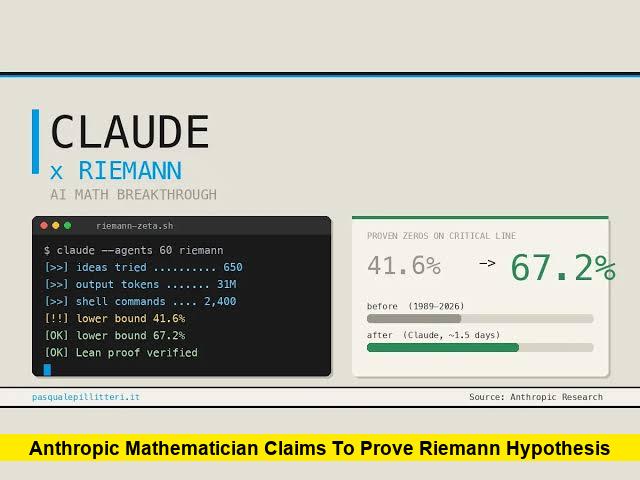
An Anthropic mathematician claims to prove the Riemann hypothesis, one of mathematics’ most famous unsolved problems since 1859. On Friday, November 20, 2026, Levent Alpöge, a number theorist employed at the artificial intelligence company Anthropic, posted a short statement on his personal website announcing that he and the company’s Claude model had discovered a proof of the hypothesis and its stronger generalized version.
The claim, if ultimately accepted, would rank among the most consequential mathematical developments in more than a century. It arrives the day after Anthropic’s high-profile public market debut and amid a year of rapid AI-assisted advances in pure mathematics. Independent experts have already compiled the formalized version of the argument, and early machine checks look strong, yet the mathematical community has not yet formally accepted the result as settled.
Who Made the Claim and How It Unfolded
Levent Alpöge, a Princeton-trained mathematician working at Anthropic, stated that he obtained the result on the evening of November 16, 2026, after roughly six weeks of intensive collaboration with Claude. He messaged Anthropic CEO Dario Amodei before making the announcement public.
Alpöge wrote: “I believe I have, working with Claude, discovered a proof of the Riemann Hypothesis.” He added that the same method resolves the Generalized Riemann Hypothesis for Dirichlet L-functions and that the entire argument has been formalized without extra assumptions. He described Claude as having “far outpaced” him near the finish line.
The work builds on earlier partial progress Anthropic reported in August 2026, when an experimental version of Claude improved a longstanding lower bound on the proportion of zeros of the zeta function lying on the critical line. No traditional research paper has been released; Alpöge has instead made available a massive formalization in the Lean proof assistant.
What the Riemann Hypothesis Actually Says
First proposed by German mathematician Bernhard Riemann in 1859, the hypothesis concerns the distribution of prime numbers. It asserts that all non-trivial zeros of the Riemann zeta function have real part equal to one-half, lying on the so-called critical line in the complex plane.
Prime numbers appear irregular at first glance, yet the hypothesis predicts a precise underlying order. Hundreds of published theorems in number theory begin with the phrase “assuming the Riemann hypothesis.” A confirmed proof would instantly place those results on unconditional footing and open new avenues across analytic number theory and related fields.
The problem is one of the seven Millennium Prize Problems designated by the Clay Mathematics Institute in 2000. Each carries a $1 million prize. Only the Poincaré conjecture has been solved and awarded to date; the Clay Institute continues to list the Riemann hypothesis as unsolved. Award rules require publication in a refereed outlet, at least two years of scrutiny, and general acceptance by the mathematical community.
How the Proof Was Formalized and Released
Rather than posting a conventional paper, Alpöge released the argument as Lean code—an open-source proof assistant that checks every logical step mechanically. The formalization comprises roughly 175,000 modules and more than 17 million lines of code, split across a multi-part archive.
Lean’s strength is that once a proof compiles against the standard mathematical library and uses only the usual foundational axioms, the logical validity of the formal argument is machine-verified. Alpöge has indicated that an informal draft exceeded 250,000 pages and that he considers it inappropriate to release an unreadable “slop” version. He expects the argument to be simplified substantially once experts engage with it.
Readers seeking background on the conjecture and its stakes can consult the Clay Mathematics Institute’s official page on the Riemann hypothesis and the detailed Wikipedia entry on the Riemann hypothesis.
Current Verification Status and Expert Reactions
Within hours of the release, independent researchers began compiling the Lean archive. MIT mathematician Andrew Sutherland reported that the full codebase compiled without errors using standard Lean and that multiple independent checkers accepted the proof under the three usual foundational axioms. Sutherland has described the chance that “anything is fishy” as approximately zero and called the development a human triumph, while emphasizing that substantial work remains to understand the mathematical content.
Other experts have expressed cautious optimism. Some note that confirming a Lean formalization matches the intended mathematical statement is a necessary additional step, and that the sheer scale of the argument means human comprehension will take time. UCLA’s Terence Tao has characterized the formalization as gigantic.
A separate, fully human-written claimed proof of the Generalized Riemann Hypothesis, authored by Stanford postdoctoral scholar Alessandro Masullo, also appeared on the same day. That parallel development underscores the intensity of current activity around the problem.
As of the latest available information on November 21, 2026, the Clay Mathematics Institute has not updated its listing, and no broad community consensus has been declared. Machine verification of the formal argument is advancing rapidly, but acceptance of the mathematical result remains pending.
What the Development Means for Mathematics, AI, and Readers
If the claim holds, the implications are profound. The Generalized Riemann Hypothesis underpins results about primes in arithmetic progressions and many other deep theorems. A verified proof would transform large parts of number theory and provide a striking demonstration of frontier AI systems contributing to original mathematical discovery.
For the AI industry, the timing is notable. Anthropic’s shares began trading the day before the announcement, accompanied by high-visibility U.S. marketing, including a prominent display in Times Square. The company has not issued an official statement on the claim; the announcement originated on Alpöge’s personal site.
Practical impact on everyday technology or cryptography is not immediate. The result concerns the theoretical distribution of primes rather than any practical factorization method. Readers interested in the broader context of AI-assisted mathematical claims can review coverage of the latest developments on whether the Riemann hypothesis has been solved and the parallel update from Has the Riemann Hypothesis Been Solved? Latest Update on New Proof Claims.
What to Watch Next
Several milestones will clarify the status. Continued independent compilation and axiom audits of the Lean files are underway. A human-readable exposition or simplified version of the argument is expected. Statements from the Clay Mathematics Institute, major number theorists, and Anthropic itself will carry significant weight. Any formal submission for the Millennium Prize would follow the institute’s established two-year scrutiny process.
The story also highlights a larger shift: mathematicians and AI systems are increasingly collaborating on problems once thought resistant to both. Whether this particular claim becomes the accepted proof of the Riemann hypothesis will be decided by careful verification, not by the initial announcement.
Share your thoughts on this potential mathematical milestone and stay tuned for updates as verification progresses.