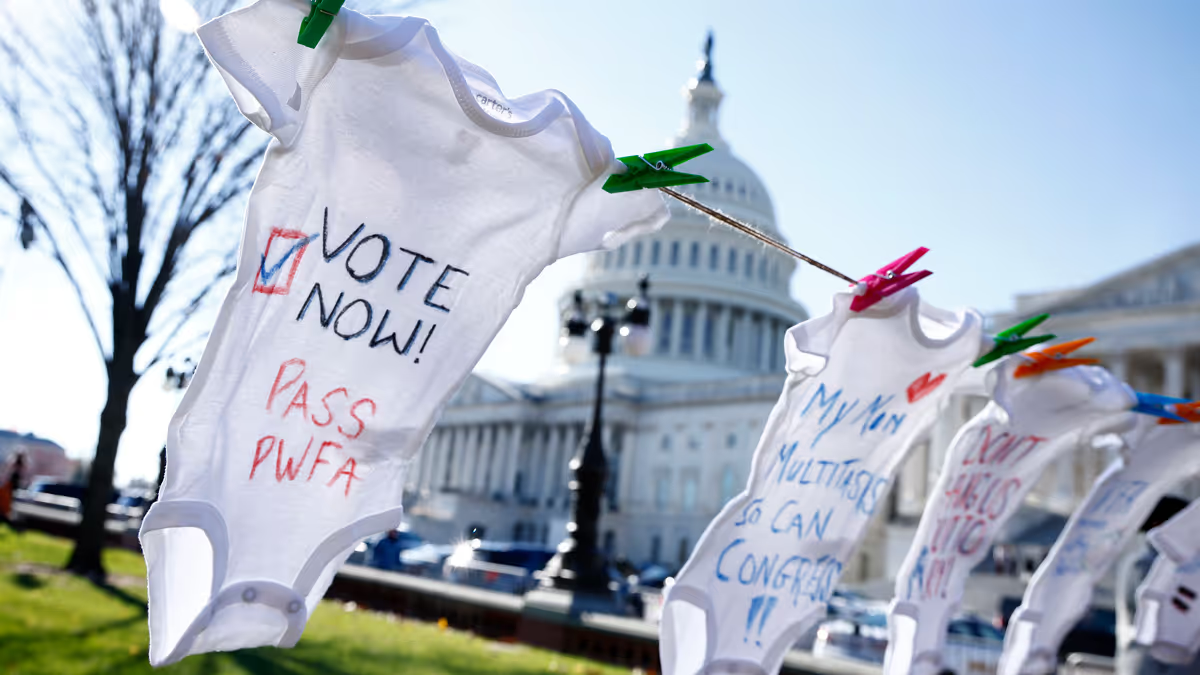
On November 20, 2026, the full U.S. Court of Appeals for the Fifth Circuit issued a 9-8 en banc decision in State of Texas v. Blanche declaring that the House of Representatives violated the Constitution’s Quorum Clause when it used COVID-era proxy voting to establish a quorum for the Consolidated Appropriations Act of 2023. The Fifth Circuit proxy voting ruling affirmed a district court injunction that bars the federal government from enforcing the Pregnant Workers Fairness Act against the State of Texas.
What the Fifth Circuit Proxy Voting Ruling Decided
Judge Cory Wilson wrote the majority opinion, joined by Chief Judge Elrod and Judges Jones, Smith, Willett, Ho, Duncan, Engelhardt, and Oldham. The court held that the Quorum Clause in Article I, Section 5 requires members of Congress to be physically present to count toward a quorum. “Proxy presence does not count,” the majority stated, emphasizing the Clause’s text, historical practice since the Founding, and Supreme Court precedent from more than 125 years ago in United States v. Ballin.
The House passed the $1.7 trillion spending package on December 23, 2022, by a vote of 225-201. Of the votes recorded, 226 were cast by proxy, meaning fewer than a majority of members were physically present in the chamber. Texas sued, arguing the law—including the Pregnant Workers Fairness Act—never validly passed. A three-judge panel had earlier reversed the district court in August 2025 and allowed enforcement, but the full court vacated that decision and reinstated the block against Texas.
Background on House Proxy Voting and the Quorum Clause
During the COVID-19 pandemic, the House adopted House Resolution 965 in May 2020, allowing members to designate a colleague to cast votes and record their presence for quorum purposes. The rule continued into the 117th Congress. Only the House used proxy voting; the Senate required in-person attendance.
The Quorum Clause states that a majority of each House “shall constitute a Quorum to do Business” and authorizes a smaller number to compel the attendance of absent members. The Fifth Circuit majority concluded that Congress’s power to set its own rules cannot override this constitutional requirement. The dissent, led by Judge James Graves and joined by six other judges (with Judge Haynes dissenting separately), argued the Constitution does not impose a categorical physical-presence rule and that the House acted within its authority during the public health emergency.
Impact on the Pregnant Workers Fairness Act
The Pregnant Workers Fairness Act, included in the Consolidated Appropriations Act of 2023 and signed into law on December 29, 2022, generally requires covered employers with 15 or more employees to provide reasonable accommodations for known limitations related to pregnancy, childbirth, or related medical conditions, unless the accommodation causes undue hardship. The U.S. Equal Employment Opportunity Commission enforces the law, which took effect in June 2023.
The court’s relief is narrow: it permanently enjoins enforcement of the PWFA only against the State of Texas as an employer. It does not invalidate the entire $1.7 trillion spending package or other provisions. Private employers in Texas and elsewhere remain subject to the law for now. Advocates have noted that the Fifth Circuit covers Texas, Louisiana, and Mississippi, and some groups argue the ruling creates broader uncertainty for pregnant workers across those states, though the injunction itself applies specifically to Texas’s challenge.
Readers seeking context on related Fifth Circuit activity can review the Fifth Circuit’s en banc ruling on constitutional claims in the Jackson water case or the recent Supreme Court election law ruling that reversed a Fifth Circuit decision.
What the Narrow Ruling Means for Texas and Beyond
For Texas state employees, the immediate effect is that the EEOC and Department of Justice cannot enforce the PWFA against the state regarding its workers. State employees may still have protections under other federal or state laws, including the Pregnancy Discrimination Act or the Americans with Disabilities Act, depending on the circumstances. Private-sector workers in Texas continue to have PWFA rights unless further litigation changes that.
The majority’s reasoning—that the Consolidated Appropriations Act of 2023 lacked a constitutionally valid quorum—could invite additional challenges to other sections of the same law, such as provisions on Ukraine aid, electoral reforms, or restrictions involving TikTok on government devices. So far, no such broader challenges have succeeded, and courts have historically been reluctant to unwind major spending legislation years after enactment. The decision is widely expected to be appealed to the U.S. Supreme Court.
What Happens Next and Why It Matters
The federal government is expected to seek Supreme Court review. A petition could be filed within the coming months, with a decision on whether to hear the case likely by mid-2027 if the Court grants certiorari. Until then, the injunction against enforcement as to Texas remains in place. Employers and workers in the Fifth Circuit should monitor developments closely, particularly any further attempts to challenge other COVID-era legislation or proxy-voting procedures.
Congressional procedure experts note that the ruling reinforces longstanding practice requiring physical presence for quorum purposes, a requirement that had not been tested in this form until the pandemic-era experiment. For pregnant workers and state employers in Texas, the practical takeaway is clear for the moment: PWFA enforcement against the state is blocked, while the broader law and its application to private employers remain intact pending any further court action.
Share your views on the Fifth Circuit proxy voting ruling and its impact on worker protections and congressional rules in the comments below, and check back for updates as the case moves forward.