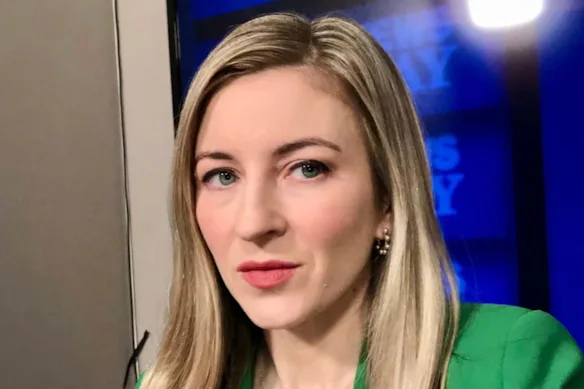
Catherine Lucey Reporter has been at the center of national attention this week after a widely discussed exchange with President Donald Trump during a press interaction aboard Air Force One. Her direct questioning on the status of recently delayed Epstein-related documents elevated her profile again and sparked conversations about press freedom, conduct toward journalists, and the responsibility of reporters working at the highest levels of U.S. politics.
In the days since the exchange, Lucey has continued her work as a White House correspondent for Bloomberg News, maintaining her position as one of the most consistently trusted reporters covering the executive branch.
Who Catherine Lucey Is and Why Her Role Matters
Catherine Lucey is a veteran political journalist whose career spans more than two decades. She has built a reputation for sharp, disciplined reporting and deep knowledge of presidential politics. Over the years, she has covered elections, policy battles, legislative negotiations, and multiple administrations.
Before joining Bloomberg News in 2025, she spent years reporting for the Associated Press and later the Wall Street Journal. Her previous roles involved covering the White House, national campaigns, and issues connected to governance, gender policy, and political strategy. These experiences helped solidify her status as a meticulous, fair, and detail-driven reporter.
Her work now centers on the daily operations of the White House, major policy announcements, and the interactions between the President and the press corps. Those responsibilities place her consistently at the forefront of breaking political news.
What Happened During the Recent Exchange
The renewed focus on Catherine Lucey followed a tense moment during a press session aboard Air Force One. When she attempted to ask President Trump about delays in releasing Epstein-related communications, the President interrupted her and directed an insult at her mid-question. The moment circulated widely across national news networks and social media shortly after it occurred.
The incident has been described by numerous media outlets as a troubling example of confrontational behavior toward journalists, especially women reporters. The remark drew strong reactions from viewers, journalists, and commentators criticizing the tone and implications of the President’s response.
Bloomberg News issued support for Catherine Lucey shortly afterward, noting the essential role of White House reporters and reaffirming the importance of journalists asking direct, accountability-focused questions.
Her Professional Standing After the Incident
Despite the moment gaining widespread attention, Catherine Lucey continues reporting as usual. Her coverage since the exchange shows no shift in tone, approach, or access. She has remained present at White House briefings, presidential travel events, and media availabilities.
Colleagues from across the Washington press corps have publicly expressed respect for her professionalism. Many noted that she remained calm and focused in the moment, continuing to fulfill her role despite the interruption.
This response aligns with her reputation. Throughout her career, Lucey has been known for focusing on fact-based questions and avoiding unnecessary conflict, even in challenging settings.
Catherine Lucey’s Background and Career Path
Below is a concise overview of her professional journey:
- Early Career: Began in local and regional reporting, building strong foundations in political journalism.
- Associated Press: Covered state and national politics, including the Iowa caucuses, a key early event in presidential election cycles.
- Wall Street Journal: Took on a broader national role, covering the White House and major policy developments.
- Bloomberg News (2025–Present): Appointed as a White House correspondent with a focus on federal policy, executive actions, gender policy issues, and political strategy.
Her reporting style emphasizes clarity, accuracy, and consistency—qualities that have made her a reliable presence in a fast-moving political environment.
Why Catherine Lucey Reporter Coverage Is Growing
Several factors contribute to the growing attention surrounding Catherine Lucey’s reporting:
1. The public interest in White House press dynamics
Interactions between presidents and journalists often become news themselves, particularly when tensions arise. Lucey’s recent exchange highlighted how tense these interactions can be, especially during politically sensitive moments.
2. The continued scrutiny surrounding Epstein-related records
Her question touched a topic that remains significant to many Americans. Any delays or controversies surrounding federal document releases naturally attract close journalistic attention.
3. Increased visibility of women in political journalism
As more women cover high-stakes political beats, moments like this spark broader discussions about gender dynamics in the press room.
4. Her respected reputation in D.C.
Lucey’s long-standing presence in political reporting gives added weight to her questions and interactions. When she is involved in a major news moment, it tends to carry more national visibility.
A Look at the Current News Climate Surrounding the Press Corps
The press corps covering the White House faces an environment in which exchanges between reporters and political leaders can quickly escalate into national stories. Catherine Lucey’s situation is an example of how:
- High-pressure environments can lead to intense exchanges
- The public closely watches how journalists are treated
- Political accountability remains a central responsibility of the press
- Reporters often become part of the news when simply doing their job
These dynamics place veteran journalists like Lucey in positions where professionalism and consistency matter greatly, both for the accuracy of their reporting and for public trust.
What to Expect Moving Forward
Journalists continue to monitor how future interactions between the administration and the press will unfold. For Catherine Lucey specifically:
- She is expected to continue asking direct questions about policy, transparency, and document handling.
- Her role in covering the White House remains central to Bloomberg’s political reporting.
- The public may see more commentary and analysis about press-president relations in the weeks ahead.
In short, the attention on Catherine Lucey Reporter reflects not only a single moment but the evolving relationship between journalists and political leadership in a highly scrutinized environment.
Conclusion
As a veteran White House correspondent, Catherine Lucey continues to play a vital role in questioning leadership, tracking developments, and ensuring the public receives timely, accurate information. Her recent interaction with the President elevated national attention, but her ongoing work speaks even more clearly to her professionalism and long-standing commitment to rigorous reporting.
Share your thoughts on Catherine Lucey’s role in today’s political landscape or tell us how you see the future of White House reporting evolving.