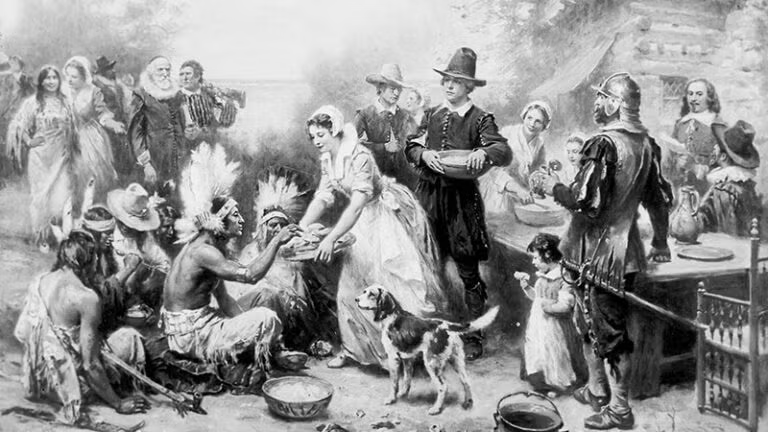
The first Thanksgiving was a harvest celebration held in the autumn of 1621 by the surviving Mayflower colonists and a large group of Wampanoag men in Plymouth, Massachusetts. Historians agree on the basics, but the popular picture of a peaceful holiday dinner leaves out a great deal.
With Thanksgiving 2026 arriving on Thursday, November 26, here is what the record actually shows about that gathering, who took part, what they ate, and how it grew into a national holiday.
What Was the First Thanksgiving?
The 1621 event was a harvest feast tied to diplomacy. It followed a hard first year in New England, when roughly half of the Mayflower passengers had died after landing in late 1620.
By the fall of 1621, the colonists had gathered a small harvest and felt secure enough to celebrate. Wampanoag leader Massasoit, also called Ousamequin, arrived with about 90 men. The English hosted them for three days of feasting and activities.
Only two firsthand descriptions of the event survive. Edward Winslow wrote one in a letter dated December 11, 1621. Governor William Bradford wrote the other in his journal. Both come from the English side, so the Wampanoag experience is missing from the written record.
When Did the First Thanksgiving Take Place?
Nobody knows the exact date. Historians place it between late September and mid-November 1621, after the harvest came in and before the ship Fortune reached Plymouth in November.
That uncertainty surprises many readers. The popular idea of a single Thursday in November comes from later centuries, not from 1621.
Who Attended the First Thanksgiving?
Around 150 people shared the occasion. The English side was small, about 50 survivors, all of them Mayflower passengers. No other ships had arrived yet.
The Wampanoag delegation outnumbered them, and the guests included Massasoit himself. Married English women and older girls handled most of the cooking, since the colony had very few adult women left after that first winter.
The accounts leave several questions open. It is unclear whether the English sent a formal invitation or the Wampanoag arrived on their own, as they had during an earlier visit in the spring. Historians at the Pilgrim Hall Museum say much of what happened face to face on those three days remains unknowable.
What Did They Eat at the First Thanksgiving?
The menu looked very different from a modern table. Winslow described colonists hunting wildfowl, which fed the company for nearly a week. The Wampanoag guests went out and killed five deer, then presented them to the colonial leaders.
Bradford’s journal says the region had plenty of wild turkeys that season, along with venison, fish such as cod and bass, and Indian corn. The surviving accounts do not mention pumpkin pie, cranberry sauce, or mashed potatoes.
Turkey was available, but no source says it was the centerpiece. Venison was likely the star of the table.
Why the Gathering Mattered: A Diplomatic Moment
In March and April 1621, the colonists and Massasoit had agreed to a treaty of mutual aid. The harvest feast helped cement that alliance.
Both sides had reasons to want it. The English were few and exposed. Between about 1616 and 1619, an epidemic that historians call the Great Dying had devastated Wampanoag communities, including the village of Patuxet where Plymouth now stands. That loss left the Wampanoag weaker against neighboring rivals, which gave Massasoit a strong reason to ally with the newcomers.
The Wampanoag arrived armed, and the English fired muskets during the gathering. Historians read both details as displays of strength on each side, not signs of a simple, carefree party.
Was It Even Called Thanksgiving?
No. The participants never used that name. The event was a harvest celebration, and the colonists did not label it a day of thanksgiving.
The first religious day of thanksgiving that Plymouth’s colonists recorded came two years later, in 1623. They set it aside after rain ended a drought that threatened their crops. It was a day of prayer, not a feast with guests.
The “First Thanksgiving” label arrived much later. Americans rediscovered Winslow’s letter in 1822, and editor Alexander Young applied the title to it in 1841. By then, the holiday already existed, and the 1621 feast gave it a founding story.
Earlier Thanksgivings in America
Plymouth was not the first European thanksgiving on the continent. Historian Michael Gannon links the founding of St. Augustine, Florida, on September 8, 1565, to a shared thanksgiving meal. Settlers at Berkeley Hundred, Virginia, held their own thanksgiving on December 4, 1619.
Native peoples across North America also held harvest festivals and giving-of-thanks ceremonies for centuries before any of these events. The Wampanoag, whose name means “People of the First Light,” had lived in the region for thousands of years. The National Library of Medicine’s Native Voices resource on the Wampanoag describes how they helped the colonists survive their first winter.
How Plymouth’s Feast Became a National Holiday
The path from 1621 to a federal holiday took more than three centuries:
- November 26, 1789: President George Washington proclaimed a day of public thanksgiving after Congress requested one.
- October 3, 1863: President Abraham Lincoln proclaimed the last Thursday of November a national day of thanksgiving during the Civil War.
- 1939 to 1941: President Franklin D. Roosevelt moved the date earlier to lengthen the holiday shopping season, and the change split the country between two Thanksgivings.
- December 26, 1941: Roosevelt signed a joint resolution fixing the holiday on the fourth Thursday of November. The law took effect in 1942.
The National Archives explains how Thanksgiving became a federal holiday, and the Library of Congress traces the legal history of presidential Thanksgiving proclamations.
The Wampanoag Perspective and the National Day of Mourning
For many Native people, Thanksgiving carries a different meaning. The 1621 alliance did not last, and the following decades brought war, disease, and loss of land for the Wampanoag. Many Native Americans note that the holiday story leaves out that later history.
Since 1970, Native people and supporters have gathered at the statue of Massasoit in Plymouth each Thanksgiving Day for the National Day of Mourning. The event honors Native ancestors and protests the myths surrounding the holiday. The Wampanoag still live in New England today.
When Is Thanksgiving 2026?
Thanksgiving falls on Thursday, November 26, 2026, the fourth Thursday of the month. It is a federal holiday under federal law, so federal offices, banks, and post offices close. Black Friday follows on November 27.
For a broader look at the holiday’s date rules, travel patterns, and traditions, read this Thanksgiving date, history and holiday traditions guide. It includes a table of upcoming Thanksgiving dates, with Thursday, November 25, 2027 next after this year.
Key Takeaways About the First Thanksgiving
- The event took place in autumn 1621, but the exact date is unknown.
- About 50 English colonists and roughly 90 Wampanoag men took part, over about three days.
- Venison and wildfowl are documented. Turkey was available but is not described as the main dish.
- The participants did not call it Thanksgiving, and the title came centuries later.
- The modern holiday took shape through Washington’s 1789 proclamation, Lincoln’s 1863 proclamation, and Congress’s 1941 law.
Understanding the full story does not require giving up the holiday. Many families now pair their dinner with a moment of honest reflection on where the tradition came from.
What did you learn about the first Thanksgiving that surprised you most? Share your thoughts in the comments below and tell us how your family marks the holiday.