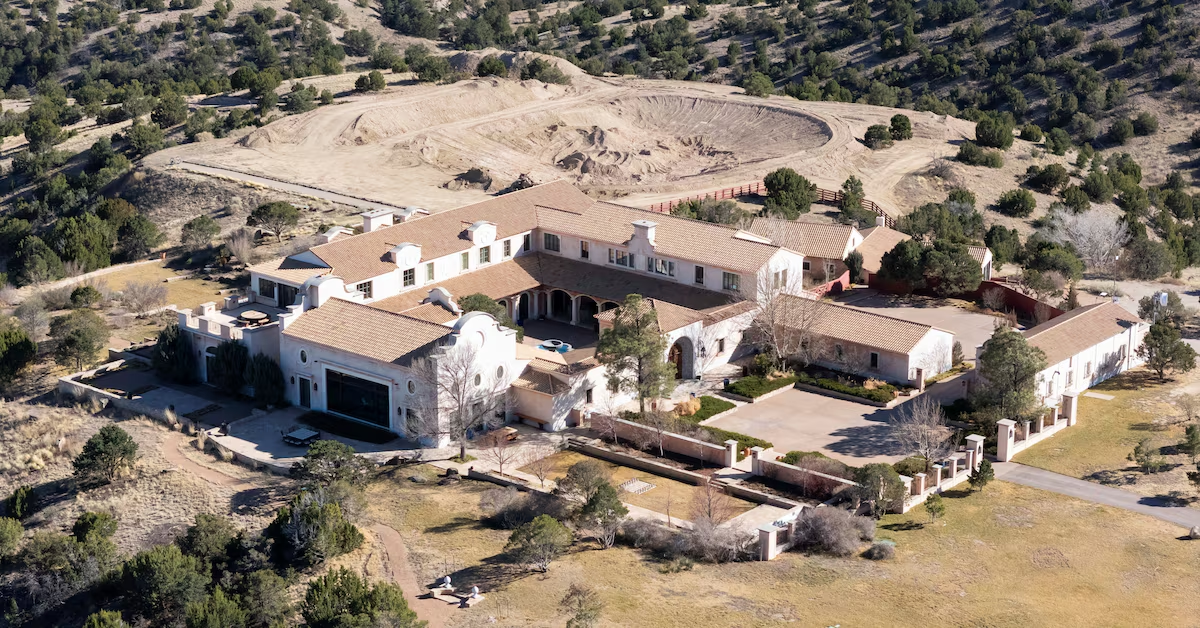
A quiet desert ranch stretching across ten thousand acres of New Mexico land is suddenly at the center of one of the most urgent public accountability debates in the country. The Epstein files search — a years-long effort to bring classified and sealed court documents into public view — has placed Jeffrey Epstein’s Zorro Ranch under a level of scrutiny it never received during his lifetime or his prosecution. And a claim that federal investigators were told to stand down from pursuing the property back in 2019 is no longer being treated as fringe speculation.
This is the story Americans are demanding answers about right now.
A Property That Was Always There — But Never Examined
Jeffrey Epstein owned real estate across multiple continents. His Manhattan townhouse. His Palm Beach estate. His private island in the U.S. Virgin Islands. These locations dominated headlines, court filings, and public consciousness for years.
Zorro Ranch was different.
The New Mexico property was vast, isolated, and — by most accounts from people familiar with Epstein’s movements — frequently used. Yet it occupied almost no space in official legal proceedings. No major criminal charges were anchored there. No sweeping federal search operations were publicized. For a location of its size and alleged significance, it moved through the justice system like a ghost.
That absence is now one of the loudest parts of the conversation.
What the New Documents Are Showing
As court-mandated disclosure processes continue releasing materials connected to Epstein and civil litigation involving his associates, a pattern has emerged that legal observers and members of the public are finding deeply troubling.
Several documents reference awareness — at the federal level — of activities connected to the New Mexico property during a window that overlaps with Epstein’s final years of freedom. The records suggest that information existed, that it was logged, and that meaningful follow-through did not happen.
Redactions cover significant portions of the most pointed pages. Names of individuals, dates of specific communications, and the identities of agents involved in certain discussions have all been obscured. The material that is visible raises questions that the material being hidden has so far refused to answer.
For the thousands of researchers, attorneys, and ordinary citizens who have spent hours combing through these releases, the ranch documents represent a thread that keeps pulling loose.
The 2019 Stand-Down Allegation, Revisited
In the months following Epstein’s death in a Manhattan detention facility, a claim surfaced through law enforcement circles that agents with knowledge of the New Mexico property had been discouraged from pursuing investigative leads tied to it. The allegation was attributed to unnamed insiders and received limited mainstream attention at the time. The news cycle was already overwhelmed with questions about how Epstein had died and what it meant for potential prosecutions of his associates.
The stand-down claim was filed away — but it was not forgotten.
What has changed in the current moment is context. The documents now emerging provide a backdrop that makes the allegation harder to dismiss. When internal records appear to confirm that federal awareness of ranch-related activity existed and produced no visible investigative action, the stand-down narrative stops sounding like rumor and starts sounding like a hypothesis worth testing.
No official body has confirmed the allegation. But no official body has seriously refuted it with evidence, either.
Why New Mexico Matters More Than People Realized
Understanding the significance of Zorro Ranch requires understanding how Epstein allegedly operated.
The private island in the Caribbean received enormous attention because it was exotic, because it had infrastructure that suggested sustained and organized activity, and because multiple witnesses placed powerful individuals there. But an island creates logistical complications. Travel records. Customs documentation. A degree of visibility that a domestic property does not carry.
A working ranch in the high desert of New Mexico, owned outright, far from major population centers, with private airstrip access — that is a different kind of location entirely. It offers discretion that an island, paradoxically, cannot always guarantee.
Survivors and advocates familiar with how trafficking operations are structured have long pointed out that the properties receiving the least public scrutiny are often the ones most worth examining. Zorro Ranch fits that profile precisely.
Public Reaction Has Reached a New Level of Intensity
The response across social media platforms has been striking in both volume and tone. Americans who follow this story — and there are millions of them — are not reacting with shock that something may have gone wrong. They are reacting with frustration that it has taken this long to reach daylight.
Posts across X, Reddit threads, Facebook groups, and independent news comment sections have generated hundreds of thousands of interactions in recent days. The dominant emotion is not disbelief. It is impatience.
Common themes in public discourse include demands for a dedicated congressional investigation focused specifically on the ranch, calls for the unsealing of remaining redacted materials connected to New Mexico, and pointed questions about which currently serving officials or public figures may have had relationships with Epstein that touched the property.
The conversation is also deeply personal for many participants. Survivors of trafficking and their advocates have spoken publicly about what it means to watch a location central to alleged abuse receive institutional protection while victims waited for accountability.
The Institutional Silence Problem
One of the most significant aspects of the current moment is not what officials have said — it is what they have not said.
No federal agency has released a statement directly engaging with the stand-down allegation in light of the new documents. No congressional committee has announced a hearing with New Mexico as a central focus. No sitting official has stepped forward to explain why the ranch received the level of investigative attention it did — or did not.
In the absence of official explanation, public trust continues to erode. Legal analysts across the political spectrum have noted that the credibility of institutions depends on their willingness to address uncomfortable questions, not simply endure the news cycle until attention moves elsewhere.
For this story, attention is not moving elsewhere.
What Accountability Could Actually Look Like
Advocates and legal experts have outlined several concrete steps they believe are necessary for the public to have confidence that the full truth about Zorro Ranch will eventually be known.
A formal congressional inquiry specifically examining federal investigative decisions related to the New Mexico property would be a starting point. This would include sworn testimony from agents and officials involved in decisions about where to focus resources and why.
Full declassification of remaining redacted materials connected to the ranch — with strict timelines rather than open-ended review processes — would give independent researchers, journalists, and attorneys the ability to do the work that institutional investigators have not completed.
An independent review of the stand-down allegation, conducted outside the chain of command that would have been responsible for any such order, is also considered essential by those who study how internal cover is maintained in federal agencies.
None of these steps have been formally initiated. Each of them has been publicly demanded.
The Larger Question This Story Forces
The Epstein case has always been about more than one man. It has been about systems — systems of access, of protection, of institutional indifference toward victims when the people involved are sufficiently powerful.
The New Mexico ranch documents are forcing a version of that question into sharper relief than ever. If investigators knew what was happening at Zorro Ranch, or had reason to investigate and chose not to, that is not a bureaucratic failure. That is a policy. And policies have authors.
Americans have watched powerful institutions close ranks around this story for years. The document releases now underway represent one of the few mechanisms available to counter that closure. Every page that becomes public is a page that cannot be managed, buried, or explained away with talking points.
The demand for accountability is not slowing down. If anything, the New Mexico chapter of the Epstein files search has given it a specific address — and that specificity is exactly what the public has been waiting for.
The comments section is open — share what you think should happen next, and check back as new documents continue to surface.