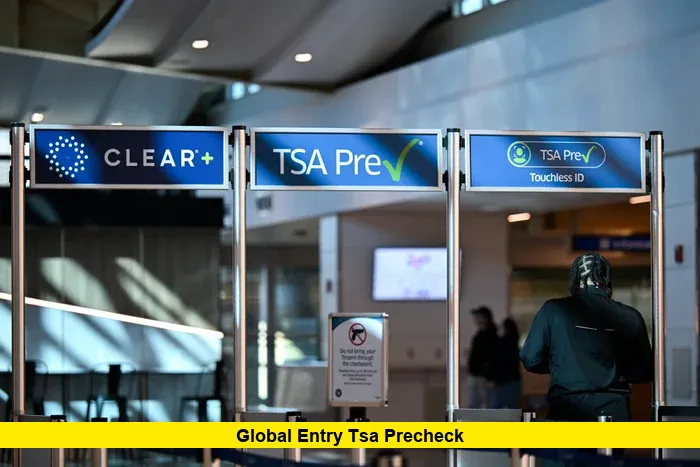
The two trusted-traveler programs that millions of Americans rely on to move quickly through airports — Global Entry and TSA PreCheck — have been officially suspended as of this morning, February 22, 2026, at 6:00 a.m. Eastern Time. The move, announced by the Department of Homeland Security, is a direct result of a partial government shutdown that has left DHS without adequate funding. If you are a member of either program and have travel plans today or in the coming days, your benefits are currently not active.
Travelers heading to the airport this weekend should plan for significantly longer wait times, bring extra patience, and prepare for the kind of security screening most PreCheck members haven’t dealt with in years — shoes off, laptops out, liquids in a bin.
→ Share this article with your travel group now so no one gets caught off guard at the checkpoint.
What Triggered the Suspension
The DHS funding shutdown began on February 14, 2026, at midnight, after Congress failed to pass a funding bill for the agency. While most of the federal government remains funded through September 30, DHS — which oversees both the Transportation Security Administration and U.S. Customs and Border Protection — has been operating without new money for over a week.
In response, DHS Secretary Kristi Noem announced a series of emergency measures to redirect limited staffing toward essential operations. Suspending PreCheck and Global Entry was among those measures. In her statement, Noem said that TSA and CBP are now “prioritizing the general traveling population at our airports and ports of entry.” She also called this “the third time that Democrat politicians have shut down this department during the 119th Congress,” and emphasized that “shutdowns have serious real-world consequences, not just for the men and women of DHS and their families who go without a paycheck, but it endangers our national security.”
DHS is also suspending airport police escorts for members of Congress and other government officials — a small but symbolically important detail that could add political pressure to resolve the funding standoff quickly.
What This Means at the Airport
For the roughly 20 million active TSA PreCheck members — a number that surpassed that milestone in 2024 — the suspension means those dedicated, shorter security lanes are not available. Travelers who would normally breeze through a PreCheck lane without removing shoes, laptops, or liquids now have to go through standard screening just like everyone else.
For Global Entry members, the impact is slightly different. Global Entry, administered by U.S. Customs and Border Protection, is primarily used by international travelers returning to the United States through automated kiosks at ports of entry. Because much of that process is automated, the exact scope of the disruption to returning international passengers is still being assessed. However, longer wait times at customs and passport control are widely anticipated.
What makes this particularly disruptive is timing. A major winter storm is forecast to impact the Mid-Atlantic and Northeast this weekend, which means airports in that region are already dealing with weather-related delays. Adding slower security lines and customs processing to that mix creates a recipe for serious airport congestion.
A Historic First
This suspension marks something genuinely unprecedented. During previous government shutdowns, TSA PreCheck lanes and Global Entry kiosks remained operational, even when enrollment was disrupted and staffing was stretched thin. This is the first time the benefits themselves — the actual expedited screening — have been formally and nationwide suspended.
That distinction matters. In past shutdowns, travelers experienced longer lines because fewer agents were available. Now, even if agents are present, the PreCheck and Global Entry systems are not being activated for enrolled members.
Approximately 95 percent of TSA workers — roughly 61,000 employees — are considered essential personnel and are required to keep working during the shutdown. However, they are doing so without pay. The remaining approximately 2,900 TSA employees have been furloughed. A senior TSA official warned lawmakers earlier this month that financial stress on employees inevitably leads to increased unscheduled absences as a shutdown drags on. When workers who live paycheck to paycheck cannot cover rent, groceries, or childcare, the number of call-outs rises — and that means fewer agents at checkpoints regardless of what the contingency plan says on paper.
What Travelers Should Do Right Now
If you have a flight today or this week, there are several practical steps worth taking immediately.
Arrive at the airport earlier than usual. Most travel experts recommend arriving at least two to three hours before a domestic flight under normal conditions. During a disruption like this one, adding another 30 to 60 minutes on top of that is a reasonable precaution, especially at large hub airports.
Do not assume your PreCheck or Global Entry benefits will be available. Even if you see a PreCheck lane open, verify with a TSA agent before entering it. The situation may evolve over the coming days depending on how quickly Congress acts on DHS funding.
Be prepared for full standard screening. That means liquids in a quart-sized bag, electronics removed from bags, shoes off, and belts off. If you haven’t done this in a while because you’ve had PreCheck for years, take a moment to mentally prepare so you’re not the person holding up the line.
Check your airline’s app and the airport’s website before leaving home. Flight delays tend to compound during security slowdowns, so real-time updates will be your best tool for adjusting your plans.
When Will PreCheck and Global Entry Come Back?
The suspension is tied directly to the DHS funding situation. Once Congress passes a funding bill and the agency receives money, DHS would be expected to restore both programs. However, there is no specific timeline. Congress is currently on a scheduled recess, which adds further uncertainty about when a resolution will come.
Historically, political pressure tends to build quickly when popular programs used by millions of middle- and upper-income travelers — people with significant political and economic influence — are disrupted. The fact that members of Congress themselves are losing their airport escorts may accelerate negotiations.
For now, though, the suspension is in effect with no end date announced.
The Bigger Picture
The suspension of Global Entry and TSA PreCheck is more than a travel inconvenience. It is a concrete demonstration of what happens when government funding disputes intersect with everyday American life. These programs exist because pre-screening and background checks allow security resources to be used more efficiently. When they go offline, the entire airport security ecosystem becomes less efficient — for everyone, not just enrolled members.
The TSA PreCheck program alone has more than 20 million active members who paid between $76.75 and $85 for a five-year membership specifically to avoid the standard security process. Those members paid for a service the government is now temporarily unable to deliver.
If the shutdown continues for weeks, the cascading effects on air travel could grow considerably worse. More call-outs from unpaid agents, longer lines, delayed flights, and frustrated travelers create a feedback loop that is difficult to control — especially with severe weather added into the mix this weekend.
If your travel plans are affected by this suspension, drop a comment below and share what you’re seeing at your airport — your experience could help other travelers prepare.